
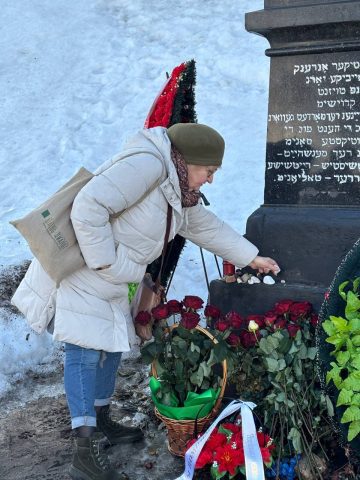
Laying stones in memory of the Jews where were killed at Yama Photo credit: The Together Plan
Introduction
“We Remember” – 84 years since the Purim pogrom at the Minsk Ghetto
By Sonya Shaipak, Minsk
There are places that hold more than history. They hold the weight of souls. For the Jewish community of Belarus, the memorial complex “Yama” (The Pit) is such a place. It stands as a silent, sacred witness to a world that was torn apart – dividing life into a quiet “before” and a traumatic, unspeakable “after”.
Today, 84 years have passed since the horror began. On 2-3 March 1942, the Minsk Ghetto became the site of one of the most brutal mass murders of the Holocaust. Historians would later call it the “Purim Pogrom”, named for the Jewish holiday falling on that same tragic day. Over two days, around 5,000 Jews were killed. Some were transported to their deaths in Koydanovo. Others, including several hundred children, were murdered and thrown into a pit right there, within the ghetto walls.
A small group gathered quietly at the foot of the Black Obelisk – the very monument erected in 1946 by surviving Jews, determined to mark the earth where their loved ones lay.
There was no ceremony. No speeches. No media. Just memory.
-
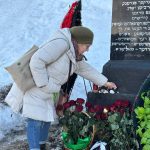
- Laying stones in memory of the Jews where were killed at Yama Photo credit: The Together Plan
-
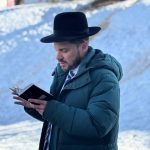
- Minsk Rabbi honouring those who were murdered 84 years ago Photo credit: The Together Plan
-

- Artur Livshyts, Chair of the Jewish Religious Union of Belarus and co-founder of The Together Plan Photo credit: The Together Plan
-
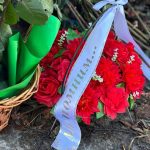
- Wreaths laid at the memorial at Yama in memory of those where were killed during the Purim pogrom Photo credit: The Together Plan
The Black Obelisk itself is a rare survivor of early post-war memory. Carved by stonemason Mordukh Sprishen, it bears an inscription in Russian and Yiddish written by the poet Khaim Maltinski: “Eternal memory to the five thousand Jews who fell at the hands of the cruel enemies of humanity – the fascist German evildoers.” For decades, this stone has stood as a quiet guardian of the dead, but is a monument which has its own story of post Holocaust Soviet Jewish suffering.
The Yiddish poet Khaim Maltinski was arrested in 1949 for writing the text that was carved on the memorial, and the Jewish stonemason Mordukh Sprishen was arrested in 1952 for his role in creating it. His crime was framed by the Soviet authorities as “Anti-Soviet activity,” specifically for participating in the creation of a monument that explicitly mentioned Jewish victims in what is believed to be the first Holocaust memorial in the Soviet Union to feature an inscription specifically mentioning Jewish victims The authorities considered the act of carving an inscription that referred directly to “Jews” rather than the ideologically acceptable “peaceful Soviet citizens” to be a manifestation of “Jewish bourgeois nationalism”. For this, he was sentenced to ten years in the Gulag
Among those who came to the memorial this year to remember were Frida Reizman, a former prisoner of the Minsk Ghetto, and Fyodor Drozd, who survived a concentration camp as a child. Bearing the weight of their years and the ache of their memories, they stood together with representatives of the Jewish Religious Union in the Republic of Belarus and members of the community. They came to say Kaddish, the prayer for the departed, and to place small stones on the cold marble – each stone a word, each stone a tear.
In 2000, the memorial was joined by a new, haunting addition: the sculpture “Those Walking to Their Death”, created by architect Leonid Levin with sculptors Elza Polak and Alexander Finsky. Twenty-seven shadow-like figures, their faces blurred in accordance with Jewish tradition, descend towards the pit. They are not individuals, but echoes – the last steps of mothers, fathers, children, neighbours. To stand before them is to feel the fear, the helplessness, the silence before the end.
-
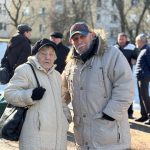
- Minsk Ghetto survivors at the gathering to commemorate the Purim Pogrom Photo credit: The Together Plan
-
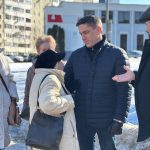
- Frida Reizman (Chair of the Minsk Holocaust Survivors’ Association) with Artur Livshyts, Chair of the Jewish Religious Union of Belarus Photo credit: The Together Plan
-
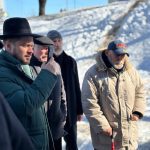
- Minsk Rabbi with survivors and attendees at Yama Photo credit: The Together Plan
-
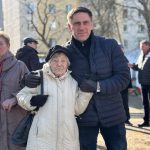
- Frida Reizman (Chair of the Minsk Holocaust Survivors’ Association) with Artur Livshyts, Chair of the Jewish Religious Union of Belarus Photo credit: The Together Plan
In early April, staff and volunteers from the Jewish Religious Union will return to the memorial. They will clean the grounds, tidy the pathways, and tend to the stones – a small but necessary act of care, ensuring this sacred place remains dignified and peaceful for all who come to remember.
We do not need words to mourn. We do not need ceremonies to honour. We simply come, stand quietly, and carry their memory forward. It is the least we owe. It is everything we have.