
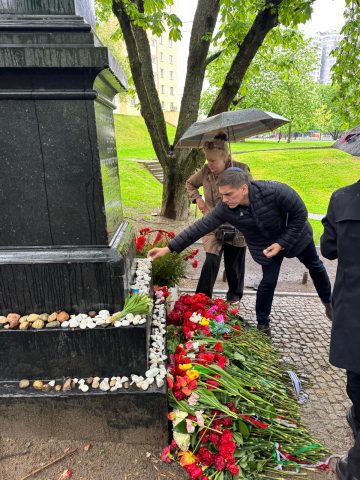
Artur Livshyts, Chair of the Jewish Religious Union of Belarus laying a stone in memory of the Jews murdered by the Nazis Image credit: The Together Plan
Each year on 9 May, countries across the former Soviet Union mark Victory Day – the anniversary of the official end of the Second World War in Europe and the defeat of Nazi Germany on 9 May 1945. For many, it is a day of remembrance, honouring the immense sacrifice and loss endured during the war.
For the Jewish community in Belarus, this commemoration holds an additional and deeply personal significance. On 9 May 1945, the date corresponded with the 26th of Iyar in the Hebrew calendar. Since then, Jewish communities across post-Soviet Belarus have marked the 26th of Iyar each year as a special day of remembrance and victory – not only to celebrate liberation from Nazi occupation, but also to affirm the survival of the Jewish people in the face of the Nazis’ systematic attempt to annihilate European Jewry.
This year, the 26th of Iyar fell on Wednesday 13 May. Rabbis, Holocaust and ghetto survivors, members of the Jewish community, and representatives of the wider Belarusian community gathered together at the Yama Memorial in Minsk to lay flowers, offer prayers, and remember those who perished.
-

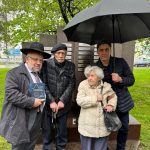
- Rabbi Mordechai Raichenstein with survivors of the Minsk Ghetto and Artur Livshyts, Chair of the Jewish Religious Union of Belarus – image credit: The Together Plan
-
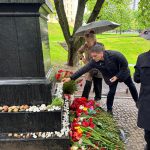
- Artur Livshyts, Chair of the Jewish Religious Union of Belarus laying a stone in memory of the Jews murdered by the Nazis Image credit: The Together Plan
-
- Members of the Jewish community of Belarus at Yama Image credit: The Together Plan

-
- Memorial candles burning at Yama Image credit: The Together Plan

The word Yama means “the pit” in Belarusian. It refers to an area within the Minsk Ghetto that had originally been a quarry bordering Ratomskaya Street. Today, the name has become synonymous with one of the most significant Holocaust memorials in Belarus.
The memorial marks the site of the largest single mass murder carried out in the Minsk Ghetto. In early 1942, the Jewish Council of the ghetto was ordered by the German authorities to assemble 5,000 Jews for deportation. As news of the order spread, many inhabitants went into hiding in the desperate hope of escaping capture.
On 2 March 1942, when it became clear that the quota had not been met, German security forces assisted by collaborators from Belarus, Lithuania, and Ukraine – entered the ghetto and began seizing people at random. Many were shot while attempting to hide or flee. More than 5,000 Jews were ultimately taken to the large pit on Ratomskaya Street and murdered there.
-
- Members of the new Maccabi team at the Yama Victory Day commemoration Image credit: The Together Plan

-
- Representatives of the Belarus Jewish community with ghetto survivors Image credit: The Together Plan

-
- The Yama memorial after it was first installed in Minsk after the war Image credit: The Holocaust Workshop, Minsk

-
- The ‘Last Way’ at Yama Image credit: The Together Plan

The memorial that now stands at Yama consists of two major elements. The first is an obelisk erected in 1947, one of the earliest Holocaust memorials in the Soviet Union. The second is the haunting bronze sculpture The Last Way, unveiled in 2000. The sculpture depicts a group of men, women, and children descending steps towards their deaths in the pit below.
The Last Way was created by Leonid Levin (1936–2014), the Belarusian architect and Chairman of the Union of Belarusian Jewish Public Associations and Communities from 1991–2014, together with Israeli sculptor Elsa Pollak and Belarusian sculptor Alexander Finski.
Inscribed on the obelisk, in both Russian and Yiddish, are the words:
“The bright memory of five thousand Jews who perished at the hands of the sworn enemies of humanity – German-fascist monsters.”