
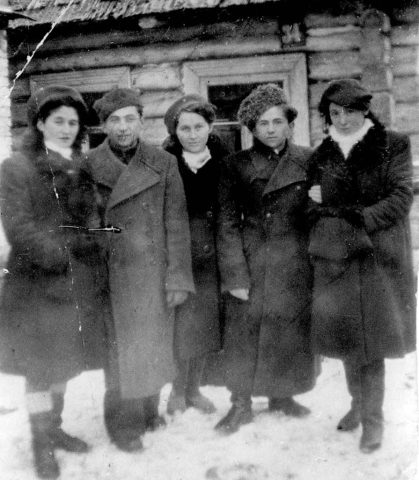
Yehudit Mirski (right) with her brothers and sisters in Nieśwież after liberation After the liquidation of the Nieśwież ghetto, Mirski survived in the Volozyn, Mir and Naliboki forests, and by joining the ranks of the partisans. Photo credit: Yad Vashem Photo Archives 1869/1028
On 8 February, we held the third talk in our campaign series to build two memorials in Nesvizh, 121 km southwest of Minsk, Belarus. The evening, “Resistance in the Nesvizh Ghetto,” brought history and personal testimony together in a powerful call to remembrance.
The first presentation was delivered by Dr Leonid (Leon) Gershovich, an independent researcher with deep personal ties to Belarus. Born in Gomel in 1981 and raised in Israel, Dr Gershovich served in the Israel Defense Forces before pursuing academic study. He earned degrees from the Hebrew University of Jerusalem and completed his PhD at Tel Aviv University in 2022, focusing on Jewish life in southeastern Belarus between 1917 and 1941. His work explores both the history of Eastern European Jewry and the way Soviet narratives continue to shape contemporary discourse on Zionism and Israel.
Dr Gershovich set the geopolitical scene of Belarus in 1941 and illuminated the extraordinary uprising in the Nesvizh Ghetto, one of the earliest and most remarkable acts of Jewish resistance during the Holocaust. In July 1942, when the Nazis moved to liquidate the ghetto, residents rose up with smuggled weapons and immense courage. Though most were killed, around forty fighters escaped to join partisan groups in the surrounding forests. Their defiance stands as a testament to Jewish resilience in the face of annihilation.
The second part of the evening brought history into sharp human focus. Dr Bernice Goll and her brother Geoff Goll shared their family’s journey from Kalisz, Poland, to New Jersey, USA. As children of Holocaust survivor Abe Goll, they grew up hearing stories of terror, loss and displacement across Poland, Belarus and Austria — including the murder of Abe’s brother, Gabriel. Yet they also spoke of the courage and resourcefulness of their grandparents, Sol and Toby Goldberg, who survived both Nazi brutality and the harsh Soviet aftermath.
Despite unimaginable suffering, their family chose not to live with hatred. They rebuilt their lives with dignity, holding fast to memory while looking toward the future. The contrast between Dr Gershovich’s historical framework and the Goll family’s lived experience was deeply moving. It transformed history from abstraction into something tangible and profoundly human.
Click on the images below to enlarge them
-
- The Partisans Kantorovitz, Shalom Chalowsky, Simcha (Sabak) Rozin Image Credit: https://www.jewishgen.org/yizkor/nesvizh/nes153.html
-
- Jewish partisans from Nieśwież in front of the destroyed Kalter Shul (Cold Synagogue) on Michaelisz Street on 2 March 1946 A battle with the Germans took place in and around this synagogue and a number of partisans were killed. From right Sergowitz, Kron, Lampert, David Farfel, Opiczinsky, Gershon Farfel, Rachel Yasinowsky, Negdiman, Yasinowsky, Michael Kutz, Baskir, Gurewitz, Gershon Pines. Seated Negdiman’s sons. Image credit: Yad Vashem Photo Archives Fo6120
-
- Yehudit Mirski (right) with her brothers and sisters in Nieśwież after liberation After the liquidation of the Nieśwież ghetto, Mirski survived in the Volozyn, Mir and Naliboki forests, and by joining the ranks of the partisans. Photo credit: Yad Vashem Photo Archives 1869/1028
-
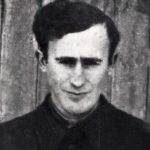
- Partisan David Farfel in 1944, after the liberation of Nieśwież and the surrounding areas by the Red Army Farfel survived the October 1941 Aktion, the liquidation of the ghetto and the uprising of July 1942, and lived for two years in the forests with a group of partisans Image credit: Yad Vashem Photo Archives 3883/3214
-
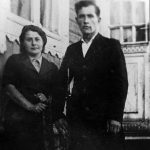
- Partisans Shalom Cholawski and Hedva (Friedl) Lahowitzky-Eichenwald after they returned to Nieśwież with the Red Army occupation of the area in July 1944. They lived with a group of partisans in the forest from 22 July 1942 until 22 July 1944 Image credit: Yad Vashem Photo Archives 7636/100
The revolt in Nesvizh was not an isolated act. As described in Shalom Cholawski’s The Jews of Bielorussia During World War II, news of resistance in places like Nowogrudek spread across the region, even reaching the Warsaw Ghetto. An underground Warsaw publication in March 1942 reported on Jews who chose to fight rather than be led to massacre sites. Even where details were imperfect, such reports strengthened morale and shaped the psychological spirit of resistance. “Nowogrudek is calling!” became a rallying cry. These fragments of shared news reveal that, even amid war and destruction, Jewish communities were communicating, inspiring and sustaining one another.
This is why our memorial campaign matters.
The Holocaust narrative in Eastern Europe, particularly across the former Soviet Union, remains underrepresented. Of the six million Jews murdered, 2.7 million were killed on Soviet territory. After the war, Soviet authorities suppressed Jewish memory; memoirs were confiscated, archives sealed, and voices silenced. The result is a fragmented public understanding of what happened in places like Belarus.
To build memorials in Nesvizh is not only to honour those who perished. It is to restore visibility to erased history and to ensure that acts of resistance, courage and humanity are remembered.
This mission feels even more urgent today. Since 7 October 2023, antisemitism has risen sharply in many parts of the world, with sustained increases in harassment, vandalism, physical assault and online hate. Education must be complete and honest. To confront hatred effectively, we must tell the whole story, not only of Western Europe, but of Eastern Europe and the lands where millions were murdered and where resistance also burned fiercely.
By marking these sites and sharing these histories, we affirm dignity, identity and truth.
Please help us bring this hidden history into the light. Your support will enable us to build two memorials in Nesvizh and ensure that this story of resilience and defiance is never forgotten.
To make a donation to the campaign to build the Nesvizh memorials, please click here.
Click here for more information from Yad Vashem and to access links to survivor video testimonies
If you missed this talk and would like to watch the recording, please get in touch using the email: [email protected]