
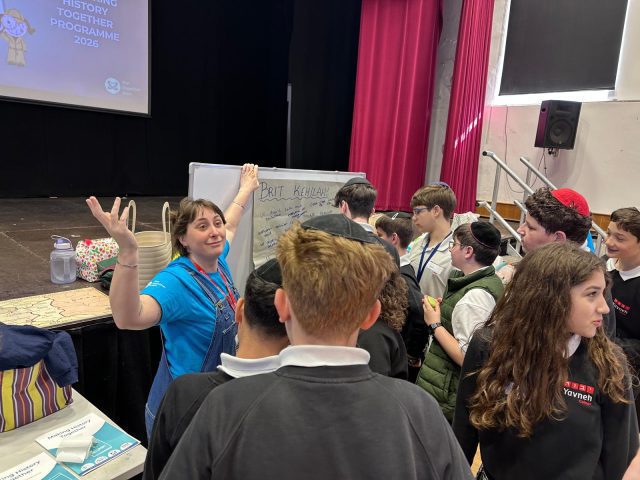
Creating a contract for the programme to agree on who we want to be in our learning space Photo credit: The Together Plan
By Jennifer K. Saber, The Together Plan Heritage Stories Reporter
CROSSING THE GATE
“Who are you here to see? Primary or secondary school?”
I paused, suddenly aware that I was on the receiving end of questioning from a burly security guard who clearly controlled whether I would make it through the thick metal security gate.
I had no idea.
Flustered, I replied, “Middle school.”
He eyed me cautiously, and I immediately realised we had run into a language barrier between my American educational vocabulary and his British one. I began explaining that I was there to work with seventh graders, only to remember that “seventh grade” was not particularly helpful in the UK either.
“Twelve and thirteen year olds?” I tried again hesitantly.
Finally, I was waved through the gates of Yavneh College for my first visit to a school in the United Kingdom. With that unnerving exchange behind me, my nervousness began to fade, quickly replaced by excitement.
THE LENS I BROUGHT WITH ME
Past the security gate, I met up with the educational team facilitating the Making History Together programme. As introductions and pleasantries were exchanged, Debra Brunner, CEO and Co-Founder of The Together Plan and author of the Making History Together programme, handed me The Together Plan’s signature teal t-shirt. I proudly pulled it on.
While I quickly found myself blending in with the team in my teal Together Plan shirt, I also carried with me the many hats I wear back home in the United States: veteran Jewish educator with more than twenty-five years of experience, Holocaust educator, teacher of B’nai Mitzvah-aged students, parent of three teenagers, and lifelong learner.
Standing at Yavneh College, I felt both curiosity and purpose as I prepared to experience the Making History Together programme in action through the lens of an American Jewish educator. I rolled up my sleeves and I dived in.
HAHEFECH: TURNING EXPECTATIONS UPSIDE DOWN
I pushed open the doors to our designated space for the day and found myself in a large open area with a stage at the front and a single row of folding chairs lining the back wall.
My mind drifted back to the stack of sourcebooks sitting beside my computer in my home office in Milwaukee that I had eagerly read cover to cover in preparation for the visit. Their pages were filled with Holocaust-related content: history, narratives, maps, timelines, and activities. I was eager to see how the staff would lift the material off the pages and bring it to life for students.
My expectations were shaped by much of the Holocaust education I had experienced in the United States: teacher-centered lessons, solemn discussions, and sombre black-and-white archival footage of the living dead. Standing in the empty room, I found myself wondering how the staff would transform the space into a place for meaningful Holocaust study for a group of twelve and thirteen year olds.
Hahefech! In Hebrew, that means “quite the opposite.” The staff completely turned my expectations on their head.
A MODERN-DAY BEIT MIDRASH
From the kickoff of the program through the rhythm of the day, I sensed something different from the Holocaust education experiences I typically encounter with tweens and teens in the United States.
Rather than feeling like a solemn lecture space, the room began to resemble a modern-day beit midrash (a Jewish house of learning) reimagined for a secondary school setting. It was filled with the very elements of Jewish education that I value most: collaborative learning, questioning, a hum of conversation, and an unmistakable buzz of excitement.
One activity in particular stood out to me. Students were divided into small groups and handed photographs of changemakers from across history and popular culture: Disney princesses, Taylor Swift, political leaders, athletes, and eventually Adolf Hitler. The students were challenged to identify the characteristics that made each person a changemaker, for better or worse.
As a veteran educator, I was struck not only by the students’ level of engagement, but by the passion and lively discussion the activity generated. Students were not passively receiving information. They were wrestling with difficult questions: Should Hitler be considered a changemaker? Can celebrities like Taylor Swift shape culture in meaningful ways? Do political leaders become changemakers because of power, influence, or ideas? Can athletes or even Disney princesses inspire social change?
Around the room, students debated perspectives, defended their opinions, challenged one another, and listened thoughtfully in return. They were not simply learning history. They were actively grappling with ideas and meaning together.
They were Making History Together.
-

- Beginning of the Making History Together programme 2026 at Yavneh College Photo credit: The Together Plan

-
- Olivia Boyd, Making History Together, Project Assistant Photo credit: The Together Plan

-
- Get to know you session with the Making History Together team and students at Yavneh College Photo credit: The Together Plan

-
- Diving into the history Photo credit: The Together Plan

-
- Members of the Making History Together team (Izzy Stafford and Sam Heller) prepping a session Photo credit: The Together Plan

THE MISSING VOICE
One of the most powerful aspects of the programme was its introduction of a missing voice in much of Holocaust education: the Belarusian experience during the Shoah. The Together Plan’s mission to bring Belarus into the canon of Holocaust education is essential to building a more complete understanding of history.
As both a former tween-aged student and current educator, I have often encountered Holocaust curricula centered primarily around the Warsaw Ghetto and Auschwitz in Poland, Anne Frank and Amsterdam, and Theresienstadt through its children’s artwork and poetry. While these narratives are critically important, I deeply appreciated The Together Plan’s commitment to widening the lens and amplifying voices from Belarus and the former Soviet Union.
The students responded with remarkable curiosity, wonder, and engagement. Debra Brunner led an active discussion exploring the experiences of those caught in the Holocaust within the Soviet Union, including the complicated realities of shifting borders and identity.
Sitting in the back of the room, I found myself amazed by the students’ enthusiasm for discussing history. Hands shot into the air in response to Debra’s questions. Students shared observations, challenged ideas, and flexed their critical thinking skills. A genuine sense of curiosity filled the room.
The students were Making History Together.
LISTENING TO THEIR OWN VOICES
Reflection served as a through line throughout the programme. I deeply value creating space for students to process and grapple with difficult topics, particularly in Holocaust education.
Each student was given a personal “Passport” to journal in over the course of the day. What struck me was the intentionality behind this practice. Not every student feels comfortable raising their hand or sharing openly in a public setting, especially when engaging with emotionally complex material.
The Together Plan staff clearly understand the importance of thoughtful pedagogy and differentiated learning. Students were offered prompts and questions, then given time and space to reflect independently in ways that felt meaningful to them. Some students wrote pages of reflections. Others sketched pictures. Some simply sat quietly in contemplation.
In a programme centered on history, identity, and human stories, the staff made sure students also had space to listen to their own voices and reactions.
The students were Making History Together.
-
- Izzy Stafford and Sam Heller following a workshop where we discover the story of a teenager who escaped from a labour camp with family photos that were hidden in his hat Photo credit: The Together Plan

-
- Diving into the history Photo credit: The Together Plan

-
- Exploring the symbolism of surviving artefacts that have stories to tell Photo credit: The Together Plan

-
- Making History Together team (left to right: Olivia Boyd, Sam Heller, Izzy Stafford, Jennifer Saber, Tracey Kieve, Debra Brunner and Abi Brunner in the front) Photo credit: The Together Plan

WHEN HISTORY BECOMES PERSONAL
As I sit back home in Wisconsin reflecting on the experience, one particular moment has stayed with me more than any other. One of the truths about teaching is that you never fully know how lessons will land or what students will ultimately connect to.
During the Changemakers activity, Adolf Hitler’s photograph was the final image analysed by my small group. By that point in the day, the students were carrying with them a range of emotions, questions, and reflections sparked by the programme.
Quietly, one student asked me if he could stomp on Hitler’s photograph. He shared that he felt a more personal connection to the image, though he chose not to explain further. I did not press him further.
That brief exchange revealed to me the true impact of the day’s learning. The Together Plan staff had cultivated a space where a student felt safe enough to express emotion and vulnerability to a complete stranger from across the pond.
In more than twenty-five years in Jewish education, I have rarely experienced a programme that fostered trust and emotional connection so quickly. Holocaust education that day was not only about timelines, geography, or historical figures. It was about helping students connect personally and emotionally to history, while leaving space for their own identities, feelings, and family stories.
Indeed this was a space to be Making History Together.
To learn more about the Making History Together Programme, read the recent article, “Making History Together – Educating the Next Generation Through Hidden History” or contact Olivia Boyd, Holocaust Education Project Assistant at [email protected].