
(Based on an interview with Mordechai (“Motke”) Morduchowicz’s son, Zvi Mor.)
Article by Jennifer Saber
Introduction:
Zvi Mor considers himself lucky. But what does luck mean in the shadow of the Shoah? Survival alone?
Zvi uses the word differently. For him, luck is not chance. It is the rare opportunity to see the world his parents lost through their eyes. In the 1990s, after the fall of the Soviet Union, he returned with his parents to their hometown of Ivenets, with them as his guides on a roots tour. They walked their hometown, letting memory do what maps could not, pointing to what had been there, and what had vanished. “My father showed us where his house was in the Jewish neighbourhood,” Zvi recalled. “That neighborhood became the ghetto. They put a fence around it. His house was inside, not far from the synagogue”.
Then he added simply. “There are no signs of Judaism in this town anymore.”
This is the story of Mordechai (“Motke”) Morduchowicz, told through the voice of his son, Zvi Mor, restoring those signs of Judaism to a landscape from which they were stripped away.
Before the Rupture
Mordechai was born in 1925 in Horodyszecze, southwest of Novogrudok, to Yitzchak and Sheina Leah Morduchowicz. He was one of five children. When he was one year old, the family moved to the town of Ivenets, northeast of Novogrudok. Mordechai’s father was a saddler, a skilled leatherworker who made and repaired harnesses and other horse gear for farmers and a nearby military camp. It was a trade that required precision and one that would later shape Motke’s survival.
But even before the war, antisemitism shaped the family’s life. Zvi recalled a story his father told him:
“The Polish asked [my grandfather] to teach a Polish goy, a youngster, his profession. So he taught him. After he learned the profession, they fired my grandfather from his job in the Polish camp. So he was sitting in the town of Ivenets with his brother, and they were smoking cigarettes and talking a lot and waiting for some farmers that would come to bring them some work for their horses. That’s how they lived.”
As a boy, Motke’s parents sent him to cheder, a traditional Jewish primary school but he did not like it and often ran away. So they decided “the best solution” for him was to send him to the Tarbut School, part of a secular, Zionist educational network. Outside of school, he spent time in a youth movement, part of a generation growing up between tradition and modernity.
The War Arrives
Motke was still a teenager when Nazi Germany occupied Ivenets in 1941. That summer, Germany launched Operation Barbarossa, the massive invasion of the Soviet Union. Within a short time, German forces swept through western Belarus, including towns like Ivenets, bringing the region under Nazi occupation.
During their roots tour years later, Zvi recorded fragments of his family’s past on an old cassette camera as his father pointed out places that no longer existed, most of all, the house where he had once lived. Standing there, Motke suddenly remembered the day the Germans came. Airplanes bombed the town, and he ran home to find his mother wounded, bleeding but alive, and their dog dead, killed in the blast. The detail startled Zvi. He had never even known they had owned a dog. Growing up, there were no dogs in the house. His father described it as a large dog, “like a wolf.”
Motke placed his mother on a horse and cart and brought her to the river to wash the blood from her body.
What stayed with Zvi was not only the story itself, but the way it returned, unexpectedly, on that very street, after so many decades of silence. His father had never told it before. It was one more reason Zvi calls himself lucky; He was there to witness memory rising up from the landscape itself, and to hear, in real time, stories that might otherwise have remained buried forever.
Ghettos and Separation
The Jews of Ivenets were forced into a ghetto established within the Jewish neighbourhood itself.
During the time Motke and his family were confined to the ghetto in their hometown of Ivenets, he was chosen by the Germans, along with a group of able-bodied men, and sent to work in the Dworzec ghetto. It was a nearby forced-labour site, one of the places to which Jews from the Novogrudok region were taken under German control. There, prisoners were made to perform backbreaking labour, hauling heavy stones from a quarry and loading them onto railway cars for German construction and rail projects. Motke was one of the unlucky men selected for this punishing work. But, as Zvi recalled, “My father, after a few days of working there, decided it’s not for him. So he decided to leave the [Dworzec] ghetto and walk back to Ivenets.”
Motke remained in the Ivenets Ghetto until its liquidation by the Germans in June 1942. That liquidation unfolded through a brutal process of selection. Jews were rounded up and divided; Those deemed unfit for labour, including many women, children, and the elderly, were taken to nearby forests and shot. Motke’s mother and some of his siblings were among them. Younger, able-bodied men like Motke and his father were spared for labour and transferred to Novogrudok, where survival depended, at least for a time, on being useful to the German war effort. Zvi explained that when they arrived, there were two ghettos in Novogrudok, “a regular one and another for the working people.” Because of Zvi’s grandfather’s skills as a leatherworker, Motke and his father were kept among the laborers. Each day, the workers crossed to the other side of town for labour and returned in the evening.
But even there, survival was fragile. Zvi describes a roundup in Novogrudok in which Jews were called up for selection, part of the German system of repeated actions used to control, exploit, and ultimately destroy the Jewish population. During that action, Motke was separated from his father, who was ill and remained behind. His father was later murdered in one of the mass shootings carried out in the forests outside the town as the ghettos of Novogrudok were gradually liquidated.
The Tunnel
As these killings continued, those still alive began to understand that their usefulness would not save them forever. Out of that realisation came a desperate and life-altering plan: to dig an escape tunnel. Stretching roughly 200 meters, it would become one of the most remarkable acts of resistance in the history of the ghettos.
Zvi said, “They decided and they succeeded and it’s an amazing story”.
Motke survived in the workers’ ghetto in Novogrudok because of his value as a skilled leatherworker, a trade he had learned from his father. His younger brother, two years younger, was there with him as well. Zvi explained that his father was given a special job in the ghetto. Each morning, a local Belarusian policeman arrived with a horse and cart, and Motke would go with him to Novogrudok to bring back bread and water in a bucket. Hidden at the bottom of that bucket, Motke smuggled items back into the ghetto, whatever was needed by those involved in digging the tunnel.
At one point, he attempted to bribe the policeman to obtain a revolver. As Zvi told it, his father handed over the money, but the next day the policeman did not appear with the revolver. Motke assumed he had stolen the money and disappeared. But a few weeks later, the man returned it. He told Motke that he had been afraid to get him a gun, and that the reason he had been absent was because his own father had called him out to the fields. “He was an honest policeman,” Zvi said. “He wasn’t a German. He was a Belarusian. A local.”
There were moments of danger even within the ghetto. Because Motke was responsible for bringing in bread and water, he had greater access than many others in the ghetto and knew more of what was happening in the kitchens and around the camp. That access also gave him a measure of contact with those in authority. On one occasion, when his younger brother was caught and faced punishment, Motke intervened and appealed to the commanding German officer, who knew him because of his daily duties. He asked that his brother be spared, and the officer agreed.
But that same access also created suspicion. Zvi said his father later told him that some people began to believe he was collaborating with the Germans. After his brother escaped punishment, the suspicion only deepened. Motke went to Berl Yezhulevich, one of the key organizers of the tunnel escape, and pleaded his case. He pointed to the risks he had taken- smuggling supplies in the bucket and attempting to obtain a weapon. Yezhulevich believed him.
The story of the tunnel has become one of the most remarkable episodes in the history of the Novogrudok Ghetto. This was a ghetto of skilled workers, and each person contributed what he could. Carpenters built supports so the tunnel would not collapse. An electrician fashioned lights and lamps. As Zvi explained, “To get air they pulled little tubes from the inside to the outside to get air to breathe. The tunnel was a metre and a half under the ground so it wasn’t so deep. The outside was a field of wheat so the Germans would not see the tubes from the tunnel.”
The Escape
On the night of September 26, 1943, the escape began.
“When they left the tunnel, it was a very dark night, September 26, 1943. It was raining, and outside it was completely dark. There was only a little light from the lamps the electrician had made, but once they came out of the tunnel, they lost their way. They had to run almost two kilometres through the fields to reach the forest, and some people, not knowing where to go, went back to the tunnel.”
In the first days after the escape, nearly half were killed, many because they lost their way in the darkness. Those who did reach the forest did so in small groups, often no more than five at a time, and most eventually made their way to the Bielski partisans. The Bielski partisans were a Jewish resistance group in the forests of Belarus, a rare refuge where those who escaped could find not only armed resistance, but also the possibility of survival.
Zvi also describes the danger of the surrounding fields, “My father was running in the field. The men were running and falling.” At one point, his father fell upon someone lying unconscious. Without stopping, he lifted the man onto his back and kept running toward the forest.
The man he was carrying was Berl Yezhulevich, one of the key organizers of the tunnel escape from the Novogrudok Ghetto
Partisan Life
After leaving the tunnel, Motke made his way to the Bielski partisans. There were two brigades: a fighting brigade and another made up of the larger camp population. Motke joined the unit responsible for placing explosives under railroad tracks. As Zvi explained, “My father would go with this unit to explode railroads.” After the war, the family still had documentation from the Bielski brigade identifying Motke as one of the fighters.
Zvi also shared another story his father told him from his partisan days. After the German defeat at Stalingrad, as German forces began retreating westward, they were increasingly afraid to pass through the forests, knowing that partisans were hiding there. One day, Motke did not have a gun, so he fashioned one himself out of wood, so it appeared real. He spotted three men running, caught up to them, and pointed the wooden stick. They raised their hands. They were three Germans. Motke took their weapons and brought them back to the Bielski camp. Zvi recalled the dark irony of the moment. The Bielskis told his father, in effect, why bring them when the goal was to kill them. According to Zvi, these were the only men his father ever killed.
During the interview, Zvi held up a small black diary that his father had taken from one of those Germans. The cover was marked 1944, and inside, in Russian, Motke had written that he kept it as a memory of the three Nazis he had captured and killed in June 1944.
After the War
After the war, Motke joined a local military police unit charged with identifying and pursuing collaborators. Zvi explained that they wore civilian clothes and spoke with local residents, trying to learn who had cooperated with the Nazis. When they heard about someone, they would bring in the police and surround the house to catch anyone trying to escape through the windows. That, Zvi said, was how collaborators were caught in the first years after the war.
It was through this work that Motke was sent to the village where Zvi’s mother lived. He stayed with her family, who were the only Jews left there. They married in 1948. With the help of another Jew, Motke found work, and he and his new wife moved into Nesvizh Castle, where he took a job overseeing the food storage. Zvi was born in 1952. Looking back on those years, he said, “At the end of the 1940s and the beginning of the 1950s, to be in charge of food is to be a god.”
The family lived in the castle with three other families who they became friends with, while the rest of the workers commuted in from town. The children played together in the outside centre area of the castle. During the interview, Zvi shared worn black-and-white photographs from that period, offering a visual glimpse into his childhood. He showed the places where he played, the children he grew up with, and a photograph in which he proudly pointed to himself in the front row smiling. There was a picture of Motke feeding pigeons, a family portrait, the kitchen staff, the doorway into their quarters, and the window to his bedroom.
-

- Nesvizh Castle Image credit: From Zvi Mor’s personal collection

-
- Nesvizh Castle Image credit: From Zvi Mor’s personal collection

-
- At the sanitorium in Nesvizh, Zvi Mor in the centre Image credit: From Zvi Mor’s personal collection

-
- The window on the left was Zvi’s bedroom window Image credit: From Zvi Mor’s personal collection

Childhood in the Shadow of Memory
Zvi’s memories of castle life were vivid and unexpectedly tender. He remembered seeing a bicycle leaning against a wall (a woman’s bicycle) and, at the age of five, climbing onto it and beginning to ride. He remembered going to the park outside, where the river widened into what they called a lake, with a beach and boats for rowing. Only later did he understand that this same landscape was also where the Germans had killed the Jews of the nearby ghetto.
One day, his mother woke him and told him quietly, “We are Jewish… and don’t tell it to anyone.” Before that, Zvi said, it had never been spoken of directly. At home, his parents spoke Yiddish to one another. Even after they came to Israel, they continued speaking Yiddish with each other and with other Jewish families. As a child, he understood that it was a language meant to remain inside the house. Once, when his parents spoke Yiddish outside, he remembers thinking: something is wrong. This language is not supposed to be outside. “I did not know what it was to be Jewish,” he said, “but I understood this language was only to be spoken inside the house.”
-
- Feeding the pigeons in the Nesvizh Castle Image credit: Zvi Mor’s personal collection

-
- Kitchen staff living in the Nesvizh Castle Image credit: Zvi Mor’s personal collection

-
- Children who were living in the Nesvizh Castle Image credit: Zvi Mor’s personal collection

-
- Nearby lake where the children played Image credit: Zvi Mor’s personal collection

Leaving Europe
Because Motke oversaw food storage, he had connections. With a few bottles of vodka, he was able to obtain a car. A friend who worked as a driver at the castle taught him to drive and helped him and his uncle obtain licenses.
“And one day we left the place,” Zvi said.
They had a friend in town who was quietly listening to an Israeli radio station. At the time, the Polish government was allowing Jews to go to Israel, and the Russians said that Polish people who wanted to go could apply. So my mother and aunt traveled to Moscow, to the Polish embassy, which was surrounded by Russian soldiers, and got papers to return to Poland. “We left Russia as Polish people, making our way back to Poland.”
Zvi remembered that journey clearly: the car was loaded onto a train, the family boarded, they crossed the border, and then, after only a few minutes, disembarked, reloaded the car, and drove all night to Warsaw.
A few days later, they arrived in Szczecin, a city that had once been German and became Polish after the war. They lived there for a couple of years. It was there, Zvi said, that he first encountered something openly Jewish. The local Jewish community had rented an apartment and turned it into a synagogue. On Simchat Torah, he was given a flag with a Magen David and an apple fixed to the handle.
“That was my first Jewish thing.”
Antisemitism and Identity
His parents ran a state grocery store. Each day they sold goods, and each morning his mother brought the previous day’s earnings to the bank.
It was in Szczecin that Zvi first became aware of antisemitism. “We were living in an apartment in the centre of the city,” he said. “My mother told me, ‘Don’t tell anyone we are Jews.’” He picked up Polish quickly and played with the neighborhood children. Once he was walking with a girl on the street when a boy came up to her and she didn’t answer him. When Zvi asked why, she said, “Don’t talk to him. He is a Jew.” They were only six or seven years old.
“Because of that,” Zvi said, “I completely forgot Polish.”
Rebuilding A Life
The family came to Israel in 1959.
“Both of my parents were optimistic people. When we came to Israel, I had many friends who were also children of Holocaust survivors, and when I visited their homes, there was often a heaviness in the air – dim lights, quiet voices, a sense that the past never fully loosened its grip. My parents were different. They lived a happy life. They were always optimistic, always looking forward rather than back. I always felt luckier than many of my friends because of that. My father spoke openly about what had happened in the ghetto, and so did my mother. They shared those stories not only with me and my sister, but with the grandchildren as well. They even took them back to see the places. I came to understand that this was not the way most Holocaust survivors lived with their memories.”
In Israel, Motke and his wife began again. Even before leaving Europe, Zvi’s mother had knitted sweaters by hand, taking measurements and delivering them within days. In Israel, she opened a stall in the market selling sweaters and wool.
Motke worked in construction, then sold ice from a mule and cart, ringing a bell through the neighbourhood. Later, he delivered furniture between cities, carrying it on his back. Eventually, he became a sales agent for a detergent and soap factory, supplying stores and hotels.
At the age of fifty, he began to lose his sight due to a rare disease. He had to give up driving and leave his business. Still, he opened a small shop and continued working. Later, he worked at a centre for blind and intellectually disabled individuals. It kept him active and engaged.
Legacy: Restoring What Was Erased
Motke died in 2013 at the age of eighty-eight. Zvi’s mother died at ninety-eight about a year ago.
When Zvi speaks about his father, he returns again and again to the same qualities: optimism, determination, and a commitment to memory.
“He was very optimistic. He always looked forward. He was a fighter. He was always talking about the Holocaust and telling everyone.”
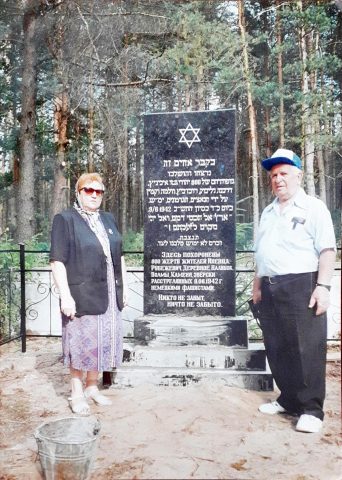
Motke returned to Ivenets and worked to restore the mass grave site. He raised money, contacted people connected to the town, and carefully documented every contribution.
What he wanted was simple: that the Jews murdered there should be named, not erased into the vague category of “Soviet citizens.” Through his efforts, a proper marker was restored.
“This is his legacy,” Zvi said.
Even after the monument was rebuilt, Motke continued to care for it, sending money to maintain it, ensuring it remained respected.
Today, it appears on Google Maps.
In the middle of the forest, the Jews of Ivenets have been placed back on the map. Another stroke of luck.
-
- Road leading to the Ivenets mass grave which was made possible through Motke’s fundraising efforts Image credit: Zvi Mor’s personal collection

-
- Renovations at the site of the Ivenets mass grave made possible by Motke Image credit: Zvi Mor’s personal collection

-
- Motke and his wife at the Ivenets mass grave memorial which they renovated Image credit: Zvi Mor’s personal collection

-
- Sign from the main road to the mass grave made possible thanks to Motke’s fundraising efforts Image credit: Zvi Mor’s personal collection

Book Recommendations by Zvi Mor:
Surviving the Holocaust With the Russian Jewish Partisans by Jack Kagan and Dov Cohen
Defiance: The Bielski Partisans by Nechama Tec
To read more about Mordechai Morduchowitz, read Tunnel of Hope: Escape from the Novogrudok Forced Labor Camp by Dr. Betty Brodsky Cohen