
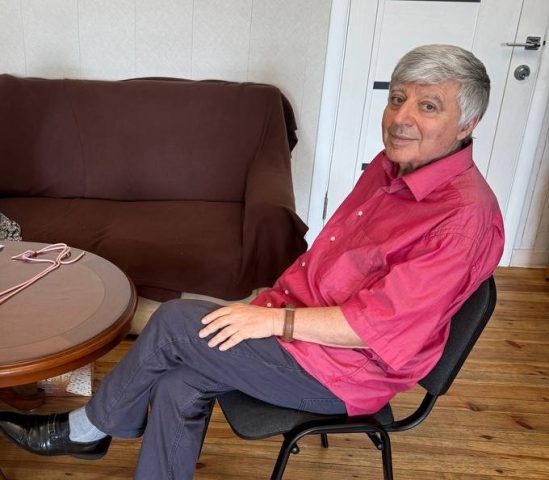
By Debra Brunner, August 3rd 2025
Vladimir (Volodya) Melnitsky is a Belarusian historian, researcher, and expert specialising in Jewish history, culture, and heritage within Belarus and he is a valued member of The Together Plan team in Belarus. He is not a state-sponsored academic but rather an independent researcher and a dedicated “root-seeker” whose work is driven by a profound personal passion for uncovering and preserving the past.
He is particularly renowned for his deep, on-the-ground knowledge of shtetls (small Jewish towns) across the country. Hi work is incredibly important as it helps to fill the gaps as the history of Belarusian Jewry was systematically erased, first by the Holocaust and then by Soviet-era suppression. His work actively reverses this erasure, specifically through his research and documentation on the 496 ghettos in Belarus.
On August 3rd, I had the opportunity to interview Vladimir. We met at the Jewish Heritage Centre at the Daumana Street Synagogue in Minsk and he told me about his life.
Debra: Can you tell me about your childhood?
Vladimir: I am from the post war generation, among those who were born during the 10 years following the end of the Second World War. I was born in 1955 and what happened to my people during the war was very painful and unbearable. My mum was lucky. Her father, my grandfather went to fight in the war, but before he left, he took my mother and two other siblings and also another girl (who later died), to the train station and they were evacuated to the Saratov area (deep inside Russia). A lot of my relatives did not survive. When the Nazis invaded and captured Belarus, many of my relatives were murdered. Many were from Starye Dorogi which is in the Minsk region.
My grandfather survived the war. After the war we counted how many of our relatives were killed in Slutsk, Bobruisk, Minsk, Starye Dorogi. Around 150 members of my family were killed.
-
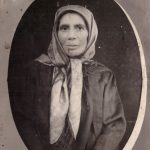
- Vladimir’s grandmother
-
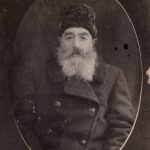
- Vladimir’s grandfather
-
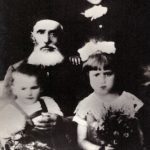
- Vladimir’s great-grandfather with his grandchildren
-
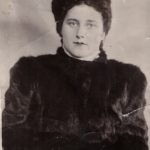
- Vladimir’s mother
-
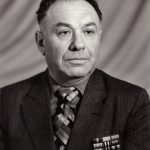
- Vladmir’s father 1985
My father was born in Ukraine. Nazis invaded Ukraine later than Belarus. My grandfather on my father’s side also went to the war to fight, but the family stayed in Kirovograd (now called Kropyvnytskyi). My father was 15 years old when the war started.
My great grandparents told to the family that the Germans were civilised people and said that they would not kill anyone. He said that there was no need to evacuate. Great grandfather said ‘we are not going anywhere’. This was two months before the occupation of Kirovograd. My grandfather and my uncle went to fight in the army and the whole family stayed. My father saw a wagon on a train with wounded people. Their heads were bandaged. Many didn’t have hands or legs. They were brought to an area where a field hospital was set up and my 15 year old father helped at the field hospital. During this time, the Commander of the brigade asked Vladimir’s father to bring hot water. Vladimir’s father was happy to help and he brought the hot water. The Commander then asked him if he was a Jew. When Vladimir’s father confirmed that he was a Jew, the Commander asked what he was doing there and why he hadn’t evacuated, telling him that in a day Kirovgrad was going to be captured by Nazis and they would kill all the Jews. The Commander told him that he was from Belarus and all his family had been killed – his wife and children and that it was not safe. Vladimir’s father explained that the elders of the family had said it would be safe to stay. The Commander’s response was – ‘go to the train station and run away.
My father ran home and told his mother that they needed to evacuate. He said he was going. His mother said she wasn’t leaving. Vladimir’s father told his mother ‘you have already lived your life, I am going’. He walked out, closed the gate behind him and started to leave. Among his family, he was referred to as ‘Sasha’ but in his passport, his name was Isaac. Whenever his mother was being strict or stern with him, she called him Isaac and at that point she called him Isaac. She told him to stop and said that they would go with him. She went back for Sasha’s younger sibling who was three years old and carrying the child, the three of them went to the train station. All the other members of the family who remained in Kirovograd were murdered apart from one of my father’s aunts.
At the train station, there was chaos. Many people were running around and you couldn’t get onto any train, but they spotted a relative on the train who was an officer in the Russian army. He took the baby through the window of the train, then went to the platform, pushed people aside and managed to get them onto the train. It was the last train that left Kirovograd before the Nazis occupied. They knew this because when they reached the next station, an announcement came across the loud speaker to say that Kirovograd had fallen to the Germans.
They went all the way to Uzbekistan and when Sasha (Isaac) turned 16 he became a volunteer in the Red Army and he went to fight. He became a special fighter who went into the occupied territory in the intelligence service. 35 times he infiltrated the enemy lines and he should have received recognition and a medal as a Hero of the Soviet Union, but this never happened because he was a Jew.
He finished the war in Kaliningrad (which used to be a German town – Konigsburg), and then the whole brigade was moved to Starye Dorogi in Belarus. This was the home town of the Commander who had originally told Sasha to run the day before the Nazis invaded Kiovgrad. It was in Starye Dorogi that my father met my mother. For 40 years Sasha served in the army. All my relatives on my father’s side were killed apart from my grandmother and the baby who evacuated to Uzbekistan. After the war they came back to Kirovgrad and then my uncle (the three year old who evacuated with my father and grandmother) went to live in Israel.
-
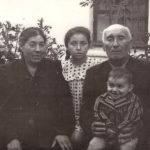
- Vladimir with his grandparents and elder sister
-
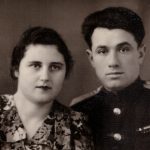
- Vladimir’s parents
-
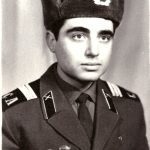
- Vladimir in 1975
-
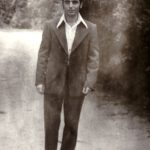
- Vladimir age 22
-
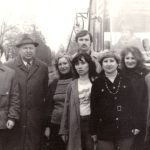
- Training to become a tour guide (Vladimir on the left)
My father’s aunt, who went to the front, married a man who was the head of the underground movement in Kirovograd. Her surname was Melnitskaya and his was Chmelnitsky but he was captured and killed. He was hanged during the war. She had to witness that but she managed to avoid capture because she was hiding and also she didn’t look Jewish. She survived and went on to marry the brother of her husband.
Debra: Your father fought for 40 years in the Red Army. He never became a partisan, so as a Jew in the Red Army, did he experience antisemitism?
Vladimir: Yes there was antisemitism. There were no Jewish generals. They didn’t allow Jews to take positions in ranks beyond that of Colonel. After the war I was doing some archive research and I found 129 cases where Jewish soldiers should have received the highest recognition medal ‘Hero of the Soviet Union’ but they didn’t because they were Jewish, so yes there was antisemitism.
During the war, there were 177 Jews who were awarded Hero of the Soviet Union medal, but there was a Commander, named Sherbakov, who in 1943 decreed that Jews should not be awarded with this medal because too many Jews were receiving it, way more than others in the country, and so he made it impossible for Jews to continue to be recognised with this honour.
Vladmir said ‘all my life, I have felt what has been done to my people, and all my life I’ve been unable to forgive Germans for what they have done’.
-
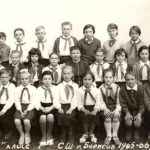
- 4th grade (Vladimir – bottom row, first from the left)
-
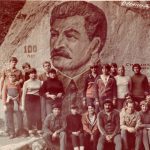
- Hiking in Ossetia (Vladimir – bottom row, first from the left)
-
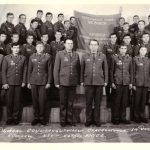
- Vladimir, serving in the army (top row, second from the left of the flag)
-
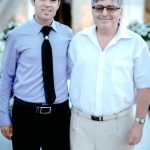
- Vladimir with his son
-
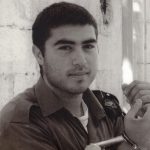
- Vladimir’s son in Israel
As I said, there were very poor German children in Konigsburg where my father ended his time during the war. They would beg for food. The Germans never gave any food to them, but when the Soviet Army took control, my father would always share his officer’s food with them. Vladimir asked him why did you do that, they were the enemy, surely they should have been killed and his father said – I am a Soviet officer and I am a Jew and I can’t do that.
Remembering what happened to all my people, I entered the Historical Faculty at the Belarus State University. I didn’t get in the first time, but because my name was not as Jewish as others, I got in on the second attempt. But in the 1970’s, when I graduated from school and especially after the Yom Kippur war, there was a huge wave of antisemitism. Jews were not allowed to enter certain universities, occupy certain professional positions.
Debra: Do you have photographs of any of the family and if so how did the photographs survive?
Vladimir: My grandmother took photos of the family with her when she left Kirovograd with my father and his baby brother, when they ran to the train station to escape. That is how I have the photographs today.
-
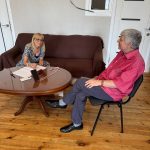
- Debra Brunner interviewing Vladimir Melnitsky in Minsk Photo caption: The Together Plan
-
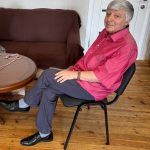
- Vladimir Melnitsky Photo caption: The Together Plan
It is interesting that in the 1990’s I was invited by the Protestant communities in other countries – in Europe and in Germany. There was a great deal of interest by students to learn about the Holocaust and recently they tried again to arrange a similar visit but they couldn’t get enough people because the interest is no longer there. There is now an immigrant population and with the change in demographic the interest is no longer there. I started to work on Holocaust research from 1973. I was publishing my articles under pseudonyms and they were distributed illegally in Belarus amongst the people in the community and those who wanted to read my research. I had to do it this way because Holocaust research was forbidden in the Soviet Union. I had to self-publish using a typewriter. People would give my publications to one another, passing them from hand to hand, and I would give secret lectures in people’s flats, in kitchens – illegally. With Perestroika everything changed and there was a revival of the community and I am very happy that I was very active in the revival of the Jewish community when Perestroika started.
When Jews evacuated to the areas of Povolzhye, Engels and Saratov (where my mother went to), there were also ethnic Germans there. These Germans were relocated which meant that there was a Russian area and a German area. When Jews arrived in Povolzhye, the local people had never seen Jews before and when they arrived, the locals would touch the heads of the Jews and say ‘but you don’t have horns, you are the same as we are’.
Debra: When did you start your work and research for your books about the ghettos in Belarus?
Vladimir: I started travelling a lot in the 1970’s to conduct interviews, visit different shtetls and places where ghettos were located. I was surprised at how many collaborators there were and how many onlookers there were. I was amazed that this was all taking place.
The figures of how many Jews were killed in Belarus vary from between 600,000 to 800,000 but according to my research over a million Belarusian Jews were killed in Belarus and that is the real figure.
Some statistics say that there were over 300 ghettos in Belarus but I have researched 495 ghettos plus one extra in Minsk. Although it is believed that there were three ghettos in Minsk, the big ghetto, small ghetto and the Sonder ghetto for the European Jews, I know that there were two Sonder ghettos which is why I say that there were actually 496 ghettos in Belarus. Within the big ghetto in Minsk there were two Sonder ghettos for the European Jews who were living separately from the Belarusian Jews.
In the Ludwigsburg archive, I was told that around 77,000 European Jews were executed in Minsk and in the whole of Belarus overall, 93,000 were killed.
Debra: In the creation of a Holocaust museum in Belarus as is now being planned, how do you feel about the difficult conversations that may come up, for example the backdrop of the antisemitism that led to the Holocaust, changing borders, building on Jewish spaces after the war.
Vladimir: We will have to face difficulties for sure, for example from the angle of the collaborators inside of Belarus. During the war the Nazis desecrated the Jewish cemeteries. After the war, there was terrible poverty and where people saw discarded gravestones they used them. It wasn’t Soviet policy. But many cemeteries ended up as empty spaces and then were built over, but they were also building on Russian Orthodox cemeteries, Catholic cemeteries and others. This was the ideology of a non-religious state. This wasn’t done to send a message to the Jews. People needed to rebuild and the land was vacant. There were no more Jews to look after the land, remember it, memorialise it, and where there were Jews who had survived, as Soviet citizens they couldn’t practice or tell their stories. Everyone was silenced.
My grandfather was very wise. In the beginning of the 1960’s there was a Tatar Muslim mosque and a Muslim cemetery in Minsk which was destroyed. The Hotel Planeta now stands where the Muslim cemetery once stood. My grandfather predicted when the Muslim mosque and cemetery was destroyed that the next would be the Cold Synagogue and indeed in 1965, the Cold Synagogue was destroyed.
Vladimir Melnitsky’s commitment and dedication to telling the history of the Jews of Belarus is unwavering. He is more than a historian; he is a dedicated preservationist and a key ally for the Jewish diaspora. His meticulous, grassroots work ensures that the rich and often tragic history of Jewish life in Belarus is not forgotten but is instead meticulously documented, remembered, and honoured. His 7 volumes on the 496 ghettos in Belarus has been written in Russian and it is hoped that we will find the support to translate and publish them in English.
The Together Plan is honoured to have Vladimir Melnitsky as one of our number and it was a personal privilege to have the opportunity to sit down with him and capture this interview in Minsk.