
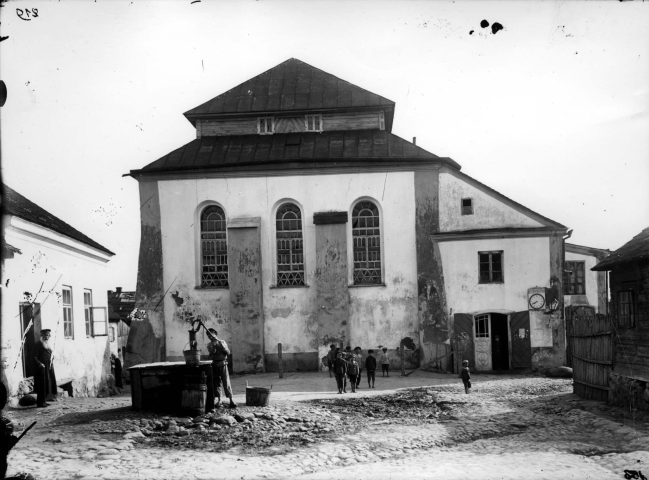
Nesvizh Synagogue Yad Vashem Photo Archive. 205AO5, 59615., Public domain, via Wikimedia Commons {{PD-US}}
Nesvizh, on the banks of the Usha River, has a history stretching back to the late 13th century. It became widely known as the main residence of the powerful Radziwill family, who transformed the town into a cultural and political centre of the Grand Duchy of Lithuania and later the Polish-Lithuanian Commonwealth. The Radziwills’ castle, built between the 16th and 19th centuries, is now a UNESCO World Heritage site and National History and Cultural Museum Reserve.
Jewish Settlement and Flourishing Life
Jewish settlement in Nesvizh began in the late 16th century. In 1586, King Stephan Batory granted Jews equal rights under Magdeburg Law. By 1589, the construction of a synagogue was authorized, and rules governing Jewish life were issued.
Over the centuries, the Jewish community grew prosperous and influential. By 1878, Jews made up 72.7% of Nesvizh’s population. They owned shops, taverns, pharmacies, and factories, contributing actively to civic life. Religious and educational institutions flourished, including synagogues, yeshivot, summer camps, and Zionist youth groups such as Hashomer Hatzair and Betar, which nurtured a connection to Jewish heritage and the dream of Eretz Israel.
“The Jews of Nesvizh played an integral role in shaping the town’s cultural, economic, and spiritual life for centuries.”
-

- Nesvizh Palace and park complex Photo credit: Horakvlado, CC BY-SA 3.0
-

- Former Jewish tavern in Nesvizh Photo credit: The Together Plan
-

- Former Jewish cemetery in Nesvizh Photo credit: The Together Plan
20th Century Turmoil and Nazi Occupation
The 20th century brought upheaval. After the Red Army entered Nesvizh in 1939, Jewish schools and organisations were closed, businesses nationalised, and residents forced onto rationing systems.
Following the German invasion of the Soviet Union in June 1941, Nesvizh fell under Nazi occupation. A Judenrat was formed to administer German orders. Mass executions began, including 1,500 Jews killed at Alba Park near the Radziwills’ castle on October 30, 1941. A ghetto was established, where life persisted under extreme danger. Residents maintained schools, synagogues, and workshops, while underground resistance groups prepared for revolt.
The Ghetto Revolt
On July 20–21, 1942, when the Nazis moved to liquidate the ghetto, an underground resistance group rose in revolt. Using smuggled weapons and improvised tools, the ghetto fighters resisted the German and Belarusian police. While most were killed, around 40 survivors escaped and joined partisan units in nearby forests.
“The revolt in the Nesvizh ghetto was one of the first armed uprisings in Eastern Europe and inspired resistance in other ghettos.”
-

- Nesvizh Partisans Kantorovitz, Shalom Chalowsky, Simcha (Sabak) Rozin Image Credit: jewishgen.org/yizkor/nesvizh
-

- Former Jewish Craftsman’s House, or House at the Market in Nesvizh Image credit: The Together Plan
-

- Nesvizh Synagogue Yad Vashem Photo Archive. 205AO5, 59615., Public domain, via Wikimedia Commons {{PD-US}}
-

- Building of the former Jewish girls school, Nesvizh Image credit: The Together Plan
Two New Memorials for Nesvizh
The Together Plan is now leading a campaign to fund a unique memorial in Nesvizh to commemorate the contribution of the Jewish community to the town. This memorial will honour centuries of Jewish life, culture, and resilience, ensuring these stories are remembered for generations to come.
Today, the site of the former Jewish cemetery in Nesvizh, once a sacred space, has become a public park. Scattered fragments of gravestones are the only visible reminder of a once-flourishing Jewish life. Without intervention, this vital piece of history risks being forgotten. As part of its fundraising efforts, The Together Plan in partnership with the Jewish Religious Union of Belarus plans to install a modest memorial at this site to ensure that the history of the cemetery, still a hallowed ground, is preserved and acknowledged.
Timeline of Jewish Nesvizh
Late 16th Century – Jewish settlement begins; granted equal rights under Magdeburg Law.
1589 – Synagogue construction begins; community regulations issued.
17th–18th Century – Jewish community prospers under Radziwill patronage; active in crafts, trade, and civic life.
1811 – 716 Jews recorded in the community; significant number of artisans.
1878 – Jewish population peaks at 5,053 (72.7% of total population).
1880s – Emigration begins due to pogroms in Russia.
1939 – Soviet occupation; Jewish schools and organizations closed.
June 27, 1941 – German troops occupy Nesvizh.
October 30, 1941 – Massacre of 1,500 Jews at Alba Park.
July 20–21, 1942 – Nesvizh ghetto revolt; around 40 survivors escape.
2025 – The Together Plan launches a campaign for two memorials in Nesvizh.
Watch The Together Plan’s film about Jewish Nesvizh
Nesvizh Fundraising Campaign
As part of the fundraising campaign in support of the two new memorials in Nesvizh, we are excited to announce our upcoming series of three online talks.
Visit our Events page to make your booking
Jewish Nesvizh – Honouring a Lost Community and Inspiring a Living Legacy
Sunday 30th November 2025 7pm UK, 9pm Israel, 10pm Belarus, 2pm EST, 11am PST.
Speakers: Tamara Vershitskaya (Belarus), Debra Brunner (UK) and Artur Livshyts (Belarus)
Little Stories of Jewish Nesvizh
Sunday 11th January 2026 7pm UK, 9pm Israel, 10pm Belarus, 2pm EST, 11am PST.
Speakers: Tamara Vershitskaya (Belarus) and Ken Domeshek (USA)
Resistance in the Nesvizh Ghetto
Sunday 8th February 2026 7pm UK, 9pm Israel, 10pm Belarus, 2pm EST, 11am PST.
Speakers: Tamara Vesrhitskaya introducing Leon Gershovich (Israel) and Bernice Goll (USA)
To learn more or to make a donation, please email us: [email protected]
Donations can be made via our USA 501(C)3 sister non-profit organization Jewish Tapestry Project. Please contact us for more information.