
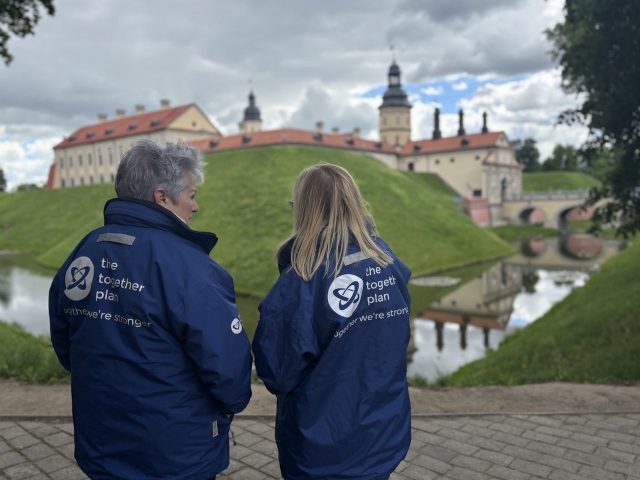
This month, The Together Plan’s CEO, Debra Brunner, travelled across Belarus accompanied by Trustee, Tracey Kieve, who was visiting the country for the very first time. The purpose of the trip was multifaceted: to provide Tracey with a deeper understanding of our work on the ground, to meet with our dedicated team in Minsk, to visit Jewish heritage sites and communities across the country, and to capture stories and experiences on film as we develop exciting new ways to bring Jewish Belarus closer to people around the world.
Over the course of the week, we travelled thousands of kilometres, exploring places rich in Jewish history, heritage, resilience and remembrance.
Our journey took us to Grodno, where we visited the magnificent Great Choral Synagogue and the historic Jewish cemetery. We met with the Rabbi there who was warm and welcoming and told us much about his plans to restore the synagogue further.
-

- Great Choral Synagogue in Grodno

-
- meeting with Rabbi Yitzchak Kofman

-
- interior view of the synagogue
-
- Debra Brunner inside the synagogue

-
- at the Jewish cemetery in Grodno

In Volozhin, we visited the world-famous Yeshiva, once a centre of Jewish learning that attracted students from across Europe and beyond. Nearby, we encountered the extremely neglected Jewish cemetery, a site that is quite literally crying out for attention and support. Here the grass was almost waist high and only the very tops of the tallest gravestones were visible. Central in the cemetery is an imposing raised platform which marks the burial site of Rabbi Chaim of Volozhin (Rav Chaim Volozhiner), the most significant rabbinic figure associated with the Volozhin Yeshiva. He was also the founder and the foremost disciple of the Vilna Gaon. The cemetery also contains the graves of other rabbis connected with the town and the yeshiva.
During the Holocaust, Jews from Volozhin were murdered in several mass killings, and some of the victims are buried in six mass graves located within or adjacent to the Jewish cemetery in Volozhin. A memorial in the cemetery specifically commemorates the Jews of Volozhin and the surrounding area who were murdered by the Nazis between 1941 and 1943, but very sadly we were not able to find it due to the overgrowth.
The Jewish cemetery in Volozhin is both a sacred resting place for generations of Jewish life and a site of Holocaust remembrance. The cemetery stands as a powerful testament to both the richness of Jewish scholarship and the devastation of Jewish Belarus during the Holocaust. But it also serves as a powerful reminder of the work still needed to preserve and protect Jewish heritage across Belarus.
-
- Volozhin Yeshiva

-
- Debra and Tracey looking at a Torah scroll

-
- inside the Volozhin Yeshiva

-
- Debra using VR goggles to study the appearance of the early 20th century synagogue

-
- burial site of Rabbi Chaim of Volozhin (Rav Chaim Volozhiner)

We continued to Ivye, home to one of the country’s most unique memorials. The central monument honours the Jewish, Muslim, Catholic and Russian Orthodox communities that lived side by side for generations, standing as a symbol of coexistence and mutual respect. Just outside Ivye, we visited the forest massacre site at Stonevichi, where more than 2,500 Jews were murdered on 12 May 1942. Standing in this quiet woodland, surrounded by nature; sounds of birds singing and tall trees that swayed above our heads in the breeze, it was impossible not to reflect on the lives lost and the importance of ensuring these stories are never forgotten.
-
- monument honours the Jewish, Muslim, Catholic and Russian Orthodox communities

-
- preserved former synagogue building in Ivyе

-
- wall with the names of the victims at the forest massacre site in Stonevichi

-
- forest massacre site in Stonevichi

Near Minsk, we visited the Khatyn Memorial, one of Belarus’s most significant memorial complexes, commemorating villages destroyed during the Second World War and the civilians who perished. Inaugurated on 5th July 1969, the Khatyn national state memorial of the Republic of Belarus is the central war memorial of Belarus for all victims of the German occupation during World War II. It commemorates particularly the more than 600 “burnt villages” which, together with their inhabitants, were destroyed by the Germans throughout the war.
In Nesvizh, we spent time focusing on a town that is particularly important to us right now. Nesvizh is the focus of our current campaign with plans tol install a memorial commemorating the extraordinary contribution made by the Jewish community to the town before its destruction in July 1942. Seeing the location firsthand reinforced the importance of this project and the need to ensure that Jewish history remains visible within the places where it unfolded.
-
- Debra and Tracey at the Khatyn Memorial Complex

-
- Khatyn Memorial Complex

-
- by the memorial dedicated to the prisoners of the Nesvizh Ghetto

-
- at the former Jewish cemetery in Nesvizh

One of the highlights of the journey was returning to Brest to visit Memory Embrace, the memorial that The Together Plan created and opened in July 2025. The memorial continues to provide a meaningful space for remembrance, education and reflection. While in Brest, we also beta-tested our brand-new Jewish Brest audio tour, which will soon allow people to discover the rich Jewish history of the city either by walking its streets in person or from the comfort of their own homes anywhere in the world.
Our travels also took us to Bronna Gora, one of the most significant Holocaust massacre sites in Belarus, where 50,000 Jews from Brest, Pinsk, Kobrin and the surrounding villages, were murdered by firing squad into mass pits, between May and November of 1942. This is a solemn site, hidden away in the forest with a solitary railway line running through it, which is why it was a perfect setting for the Nazis to carry out their plans of mass destruction of the Jewish communities in the Brest region. Visiting these places is always deeply moving and reinforces why preserving memory remains at the heart of our work.
-
- visiting the Memory Embrace memorial in Brest

-
- visiting the Memory Embrace memorial in Brest

-
- beta-testing the Jewish Brest audio tour

-
- beta-testing the Jewish Brest audio tour

-
- walking through the railway crossing at Bronna Gora

In Minsk, we visited the British Embassy and met with the Chargé d’Affaires, David Ward to discuss a number of projects including plans to develop our Making History Together programme in the UK. David Ward also joined us at the Minsk Jewish Heritage Centre for a historic signing of an agreement with the Mir (Peace) Foundation, which is bringing together the major religious denominations in Belarus to work on collaborative projects. The first project will be a campaign to build a historic wall of memory to commemorate the 503 ghettos that the Nazis created in Belarus, between 1941 an 1944. At the Minsk Jewish Heritage Centre (which was made possible with The Together Plan’s support), we met community members, attended a variety of events and were delighted to see the space alive with activity. In this space. we also met with representatives from the newly formed Maccabi in Belarus organisation, and the Rotary Club to discuss possible collaborative projects.
Throughout the week, we met with community members, Rabbis and partners in Grodno, Minsk and Brest. Everywhere we went, we were welcomed with warmth, generosity and friendship. These relationships are the foundation of everything we do and remind us that Jewish Belarus is not simply a story of the past, it is also a living community with a future.
-
- meeting with representatives of Maccabi.BY

-
- meeting with David Ward, Chargé d’Affaires ad interim of the United Kingdom to the Republic of Belarus

-
- meeting with a representative of Rotary Club Belarus

-
- working on the road

As we move forward with our new strategy, we are excited to share more of Jewish Belarus through film, digital storytelling, virtual experiences, talks and opportunities for people to engage directly with this remarkable heritage. There is simply so much to share.
We have many new plans in development and look forward to offering exciting new ways for you to connect with the places, people and stories that make Jewish Belarus so special. Watch out for the ‘Community Coffee Club’, which we will soon be launching. It will be your chance to support us, join the community and get closer to the work we do.
If you have ever considered travelling to Belarus yourself, we would be delighted to help you plan your visit. Whether you are exploring family roots, Jewish heritage, Holocaust history or simply wish to experience this fascinating country, our team is ready to welcome you and help create a meaningful and memorable journey.
Watch this space, there is so much more to come.
To support the work of The Together Plan click here (donations can be made to The Together Plan in the UK or Jewish Tapestry Project in the USA) or email us [email protected]