
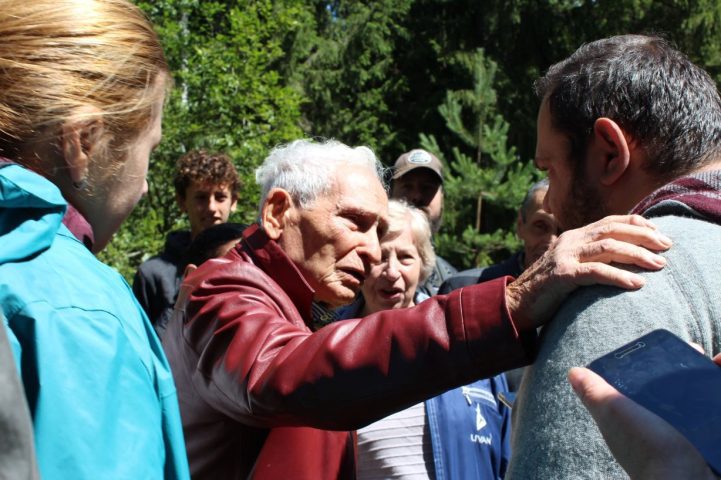
Aron at the reunion of Bielski partisans descendants in the Bielski Camp 2019 Naliboki Forest Image credit: From Tamara Vershitskaya's personal collection
By Tamara Vershitskaya
Most people in the village called him Archik Bielski. He was the youngest of twelve children in the family of David and Beila Bielski. Aron was born in 1927 in Stankievichi, a small village of sixteen houses fifteen kilometres from Novogrudok, which was at that time a part of Poland. His parents had a watermill on the river Niezhatka and the Bielskis were the only Jewish family in the village. Aron was a joy to his parents, the apple of their eye. He was ‘little brother Areleh’ for his three elder brothers – Tuvia, Asoel and Zus. These were the honourable and brave Bielskis who led a remarkable rescue effort in Nazi-occupied Belarus during World War II celebrated for saving over 1,200 Jews from the Holocaust, not by fighting alone, but by establishing a large, hidden forest community, often called a “forest village,” that included fighters, women, children, and the elderly.
In November 1941, local non-Jews recalled how miserable and frightened Archik was, when he came running to the neighbouring village of Ugly (Углы), to hide with a Christian family. He was fleeing the police who had come to arrest his parents. When he and the other Bielskis were hiding during that first winter under the Nazi occupation (1941-42) with the Zhod’ family in the same village, they had to spend an entire day in the forest. They would come to the house to eat and sleep only when it got dark. Archik would fall asleep on the floor in front of the stove before they were given some food, because he was so cold and tired. Later, when the Bielskis grew into a partisan detachment, he would come at night, deadly tired, to the Duchovniks in Malaya Izva because they baked bread for the Bielski partisans. He would immediately fall asleep sitting at the table having first placed a hand grenade in front of him.
-
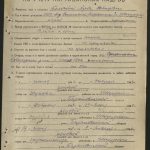
- Aron’s Partisan personal card (page 1) Image credit NARB National Historical Archives of Belarus from Tamara Vershitskaya’s personal collection
-
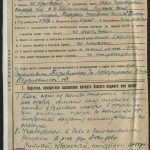
- Aron Bielski’s Award certificate for the medal of the Partisan of the Patriotic War second degree. Image credit: NARB National Historical Archives of Belarus from Tamara Vershitskaya’s personal collection
-
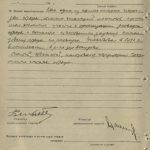
- Aron’s Partisan personal card (page 2) Image credit NARB National Historical Archives of Belarus from Tamara Vershitskaya’s personal collection
-
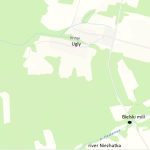
- Map showing the location of the village of Ugly (Углы) in relation to Stankievichi
-
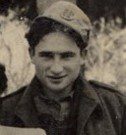
- Aron Bielski after liberation in 1944 Photo from Tamara Vershitskaya’s personal collection
*See below for the translation of Aron Bielski’s Partisan personal card (pages one and two above)
He was fourteen when the Nazis came and ruined his happy life. Oh how he loved his Stankievichi surrounded by forests! He cherished these memories and kept them in the depth of his heart all his life.
‘I rode my horse, or one of the other horses we had on the farm, every night, through the night. I rode deep into the forests and deep into the nights – in search of richer pastures. I can even now remember the cold night mists, the cold and sometimes biting night winds through the trees and across the fields. I think I miss these winds and mists, and breezes, living now in Palm Beach, where the breezes from the sea bring moist sea smells. The winds of the Belarusian forests were sharper, harsher. They would gust under your jacket, under your shirt even, and caress your skin with a sudden cool gust that made you shiver for a moment. And the smell, the moist, earthy sweet smell of grasses, of the flowers, of the mosses and the ferns, and the damp smell of the earth and the rich smell of the warm-cold soil. Warmed in the day by a high, high sun and cooled in the night, the soil gave its heat to the air and its earthy smells surrounded us. All these sensations, all these moonlit landscapes were so familiar to me that I knew this world of the night as well as I knew the nooks and crannies of the farm. I didn’t know, yet, that this deep and natural familiarity with the forest in all its aspects would some day save my life and others lives’.
This is how Aron Bell (Archik Bielski) put his memories and feelings on paper in his memoirs entitled ‘Forest scout’, self published in 2014 .
He became a scout and a liaison for his brothers in the forest. From the very beginning of their partisan life Aron was with his brothers and participated in decision making. Tuvia Bielski, the commander, writes repeatedly about his little brother in his unpublished memoirs.
“We discussed the need to get settled in the forest for two important reasons: first, to evade the unfortunate situation under the German and civilian enemies, and second, to organize a force of men from the ghetto as long as the remaining Jews there were not liquidated.
During our discussion, little Areleh would listen and smile, saying that we had nothing to fear because we knew the area and the forest better than the Germans. One thing was a problem, however, and that was if women, children and the elderly would join us, how there would be food for them, and how they would hide?
Time is the best teacher! This was my response”.
Aron was a man of few words. In fact, he remained silent for three months after the arrest and death of his parents in December 1941. Life in the forest was a constant series of trials.
“During those days and nights of wandering when the sky became covered with dark clouds to the point of darkness and chaos, there was yet another problem, i.e. the growth of so-called partisan bandit groups. Under such circumstances, of course, this was on everyone’s mind, and therefore everyone had to be very careful not to irritate these so-called heroes. One of them captured a partisan from my unit and told him to hand over his gun, and when the partisan refused, he turned into a casualty at the hands of this so-called partisan group.
A second one took the weapons, watches, and other belongings of four other partisans, and they took my brother Areleh’s semi-automatic gun, his watch and a pistol. The same thing happened to Moshe Resnick, a talented young man and a good partisan, as well as to many others. In short, the barbaric acts were shrouded in mystery. There was only one thing left to do: make every effort to cover their tracks. Areleh said that he knew them, and that these bandits were staying in a nearby hamlet. For this purpose we soon sent out 100 men with appropriate weapons and decided to undertake a battle to the last man”.
In the forest Aron was protected by his brothers and felt safe in spite of the war. Everybody in the camp wanted to make friends with him. In 1945, when the war finished, his life shattered again. Tuvia, Zus, their wives and Chaya, who was married to the third brother, Asoel, emigrated to build their new lives elsewhere: first to Europe, from there to Israel and finally they settled in the USA. Nineteen-year-old Aron was left by himself. He didn’t have a family of his own and didn’t want to be a burden to his brothers. He missed Asoel, who had been drafted into the Red Army after the liberation of Belarus in 1944 and fell at the front in the Polish city of Malbork.
Alone and unhappy, Aron moved from a displaced persons camp in Italy to Israel, where he served five years in the Israel Defense Forces. In 1954, he bought a one-way ticket and arrived in the United States. He had no money, couldn’t find a job, and after a month of fruitless attempts, he decided to return to Europe. How could he buy a ticket? Someone suggested asking an Italian Jewish banker for help. The banker, in turn, asked Aron how he could be sure Aron would pay him back. And instead of giving him the money, the banker hired Aron as a driver. A month later, Aron bought himself a car. Then another, and another. Thus, he founded his own taxi company and became more successful than his older brothers in the new world. In his own words: “America was a paradise unheard of after the war”.
-
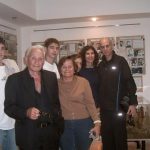
- Aron Bell with his wife Henryka, his son Alan, daughter-in-law, two grandsons and a granddaughter in the Jewish Museum in Minsk 2006. Image credit: from Tamara Vershitskaya’s personal collection
-
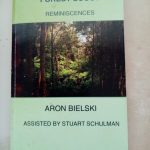
- Forest Scout, Reminiscences by Aron Bielski Photo credit Tamara Vershitskaya
-
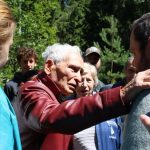
- Aron at the reunion of Bielski partisans descendants in the Bielski Camp 2019 Naliboki Forest Image credit: From Tamara Vershitskaya’s personal collection
Aron dedicated his memoirs to his parents and to his brothers – Tuvia, Asoel and Zus who were real heroes for him. He was married twice, had three children, 20 grandchildren and great grandchildren and he left a message to them and to all of us:
Love as much as you can.
Be a warrior.
Be always in the truth.
Pray.
Be a warrior again.
*Translation of Aron Bielski’s Partisan personal card (pages 1 and 2):
Personal Card
-
Surname, name, patronymic: Bielski Aron Davidiovich
-
Year and place of birth: Born in 1927 in the village of Stankievichi, Pietrevichi Village Council, Novogrudok district.
-
Nationality: A Jew
-
Social status: a peasant
-
Time when he joined the All-Union Young Communists League: 1944
-
Education: elementary
-
When and by whom was conscripted into the Red Army: he wasn’t
-
Participation at the front: didn’t participate
-
Where from did he come to the partisan detachment? The village of Stankievichi, Novogrudok District, July 1941. A peasant.
-
Was he captured prisoner? No, he wasn’t.
-
What partisan detachment did he belong to? Rank and area of location:
From July 1941 to February 1943 – detachment named after Zhukov, Novogrudok district, Baranovichi region;
From February 1943 to July 19, 1943 – private, detachment Oktyabr, Novogrudok district, Baranovichi region
From July 19, 1943 to January 3, 1944 – private, detachment Odzhonikidze, Novogrudok district, Baranovichi region
From January 3, 1944 to July 12, 1944 – private, detachment named after Kalinin, Novogrudok district, Baranovichi region
-
Wounds and contusions: the village of Stara Huta, Novogrudok district.
In May 1943 wounded into his left leg.
-
Awards: Wasn’t awarded
-
Marital status and address: a bachelor, Lida, the name of the street unreadable, 4.