
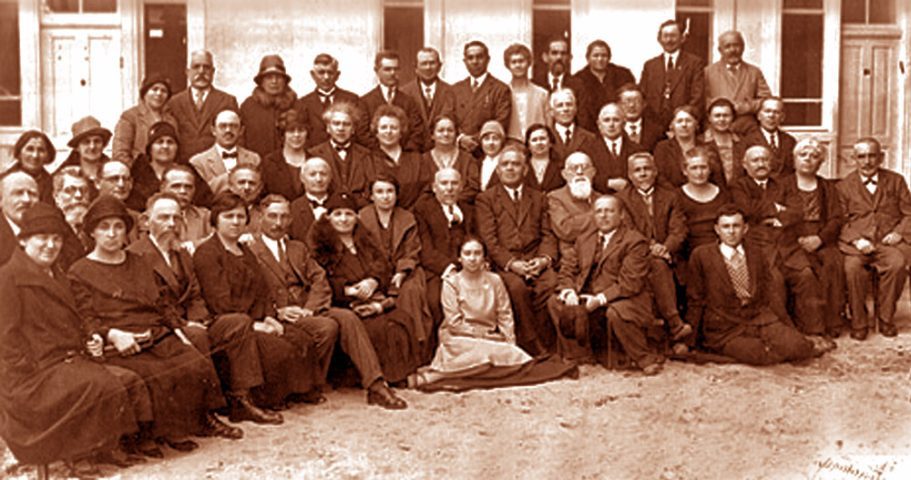
Ahuzat Bayit 1929. Akiva Arieh Weiss front row, centre. Photo credit: Unknown author Public domain, via Wikimedia Commons
At The Together Plan, our work is deeply rooted in the history of Jewish life in Belarus. We look back to understand the present, uncovering powerful, and often little known, stories of resilience that resonate with our mission. One such story begins in the cramped, impoverished shtetls of the Pale of Settlement and takes us to the sun-drenched dunes of the Mediterranean.
For over 120 years, from 1791 to 1917, millions of Jews in the Russian Empire, which includes the territory that is modern-day Belarus, were confined to the Pale. This was a region of limited opportunity, pervasive discrimination, and often violent pogroms. Life was defined by legal restrictions—on movement, profession, and education. For many, the future seemed like a closed door.
Yet, from this crucible of oppression emerged a desperate need for a solution. It was in this context that a new idea found fertile ground: political Zionism.
Theodor Herzl and the birth of political Zionism
The yearning for Zion is ancient because it is deeply woven into the very fabric of Jewish religious, historical, and cultural identity. It is far more than a political aspiration; it is a central pillar of Jewish belief and practice that has persisted for millennia since the exile. This profound connection was not merely established when the Jewish people lived in the land; it was intensified, codified, and eternally cemented during the long centuries when they were exiled from it.
The experience of exile—a trauma repeated multiple times but most definitively by the Roman Empire—transformed the physical land of Israel into an indelible spiritual and national homeland.
While the yearning for Zion is ancient, modern political Zionism was crystallised by a Viennese journalist named Theodor Herzl. Witnessing the rampant anti-Semitism of Europe, most famously the Dreyfus Affair in France, Herzl concluded that assimilation was impossible and that hatred of Jews was an ineradicable feature of the diaspora.
In 1896, he published a pamphlet, Der Judenstaat (The Jewish State), which argued for a radical, political solution: the establishment of a sovereign state for the Jewish people, guaranteed by international law. A year later, he convened the First Zionist Congress in Basel, Switzerland, creating the World Zionist Organization to serve as the diplomatic and political engine for this goal.
Herzl’s genius was to transform a spiritual longing into a concrete political programme. He famously wrote, “If you will it, it is no dream,” and tirelessly met with emperors, sultans, and diplomats to seek a charter for a Jewish homeland. For the millions of Jews suffering in the Pale of Settlement, Herzl’s vision was not abstract; it was a lifeline. It gave a name to their longing and a structured hope for a future where they could live freely, away from the suffering and as masters of their own destiny.
-
- Building houses in Tel Aviv 1920 Photo credit: פרנק סחולטן, Public domain, via Wikimedia Commons
-
- Ahuzat Bayit 1929. Akiva Arieh Weiss front row, centre. Photo credit: Unknown author Public domain, via Wikimedia Commons
-
- The 66 families, members of the “Achuzat Bayit” house building association, drawing lots for the 60 plots on which to build, on the 12-acre piece of land the association had acquired. Photo by Avraham Soskin, April 1909Avraham Soskin, Public domain, via Wikimedia Commons {{PD-US}}.
-
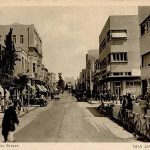
- Tel-Aviv Herzl Street 1930s Photo credit: Edition Moshe Ordmann, Public domain, via Wikimedia Commons
Akiva Arieh Weiss answers the call
Akiva Arieh Weiss was born in 1868 in the Grodno Governorate, a region deeply embedded in the history of the Pale and now part of modern-day Belarus. A watchmaker by trade and a visionary by nature, Weiss embodied the shift from political theory to practical action. He left behind the constraints of the Russian Empire and made the arduous journey to Palestine in 1906.
He carried with him the collective hope of a people seeking a legal and legitimate foothold in their historic land. This was the fundamental Zionist response to centuries of disenfranchisement: not to take, but to build; not to seize, but to purchase; not to operate in shadows, but in the full light of the law—a direct rebuttal to the lawlessness they had endured.
Weiss became the leader of the Ahuzat Bayit association, a group of 66 families determined to create a new Hebrew suburb outside the crowded port of Jaffa. Their project would become the first neighbourhood of Tel Aviv. And from the very start, their methodology was a direct rejection of the powerlessness they had known in the Pale.
a scrupulous adherence to law: the foundation of Tel Aviv
The founders of Tel Aviv were not rogue settlers. They were meticulous builders, determined to ensure their project’s legitimacy and long-term security under Ottoman rule. Their process stands as a powerful testament to their principles:
- Legal Purchase from Willing Sellers: The land north of Jaffa was not “empty.” It was acquired through official channels from its recognised owners, primarily three Christian-Arab families in Jaffa: the Kassars, the Salamas, and the Al-Ayyans.
- Operating Within the Framework: Every transaction was conducted under the Ottoman Land Code of 1858. Jewish brokers, experts in local law, negotiated the complex purchase of multiple adjacent parcels.
- Official Registration and Approval: The association paid a significant sum of 273,939 French Francs. Most crucially, the sale was officially registered in Jaffa’s Ottoman land registry, and the association received its Kushan—the incontestable Ottoman title deed. The entire project was sanctioned by the Ottoman governor and approved by the municipal government.
The founding of Tel Aviv was a legal real estate transaction between willing buyers and sellers. This unwavering commitment to legality was the bedrock of their vision, a stark contrast to the arbitrary lawlessness that had defined their existence in the Pale.
The story of Akiva Weiss is just one of many stories demonstrating what Jewish Belarusians, forged in the hardship of the Pale, went on to achieve in the world. It is a story of turning Herzl’s political vision into a tangible reality through perseverance, unity, and an unwavering respect for the law. Sadly, Akiva Weiss did not live to see Israel’s independence in 1948, as he passed away in 1947 — but how proud he would be to witness the vibrant city that Tel Aviv has become today.
We will continue to research and tell these little known stories as part of our work to build our Belarus Jewish Heritage Route. To support our work in rebuilding Jewish life in Belarus, please consider donating today, or become a member of our Community Coffee Club to get closer to the work that we do.
Over the coming months, we will be doing a special series on some of the little known Jewish Belarusians who played key roles in the building of modern day Israel.