
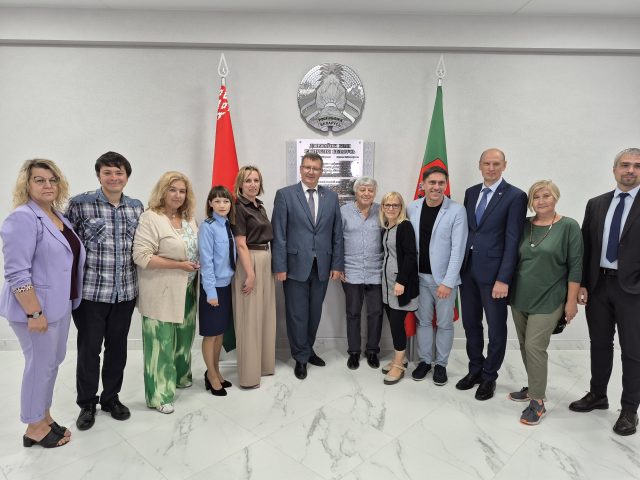
Delegates at the symposium Photo credit: Neil Adams
By Neil Adams, 26th July, Novogrudok, Belarus
Following the signing of a landmark agreement, on July 10th, to establish the Belarusian Museum of the Holocaust and Resistance in the historic town of Novogrudok the International Symposium ‘Belarusian Holocaust and Resistance Museum in Novogrudok’ took place on July 25th. The event was organised by the Jewish Religious Union in the Republic in Belarus, Together Plan’s official partner in Belarus and took place at the offices of the Municipality in Novogrudok. Artur Livshyts the co-founder of The Together Plan and the Chairman of the Jewish Religious Union since 2023 co-facilitated the symposium alongside Novogrudok based Tamara Vershitskaya (Jewish Heritage Specialist at The Together Plan). Sonya Shaipak and Vasily Zaitsau from the team based in the Minsk office played a key role in the organisation and running of the event. I travelled to Belarus with Debra Brunner the co-founder and CEO of The Together Plan and accompanied her to the event. This was a truly historic day that marked the end of one long and challenging journey that The Together Plan has been working on for the past 12 years – the creation of a unique memorial on the territory of the Brest-Litovsk Jewish cemetery in the south of the country, which will be officially opened on July 28th – and the start of another.
-
- Talk by representative of Grodno Region Prosecutors Office Photo credit: Neil Adams
-
- Talk by Belarusian historian Vladimir Melnitsky who has written 7 volumes on the 496 ghettos in Belarus Photo credit: Neil Adams
-
- Opening of the symposium in Novogrudok Photo credit: Neil Adams
The main aim of the symposium was for the 3 key project partners in Belarus; the Jewish Religious Union in the Republic of Belarus, the MIR Foundation for Peace and the Novogrudok District Executive Committee, to sign a Memorandum of Understanding to take steps to create Belarus’s first Holocaust Museum. This long awaited museum will extend the footprint of the Museum of Jewish Resistance Museum in Novogrudok, a tiny museum that was established in 2007 by Jack Kagan with oversight by Tamara Vershitskaya. This incredibly important museum tells a very big story but has a little known presence.
The participants included a host of internationally renowned experts, guest speakers and historians representing Belarus, the UK, Israel and Canada, with some attending in person and others joining via Zoom. The aim of the symposium was to open the dialogue and explore the concept and context for the Museum’s creation and propose and accept a Memorandum of Understanding of the key partners. The diversity of the backgrounds and experiences of the speakers and participants provided a sound foundation as a starting point for what is to follow. Speakers included native Belarusian second generation survivors as well as second generation survivors in the Diaspora which added authenticity, meaning and rich context.
The ultimate aim is to create a leading international centre of remembrance, education and research that will put the heritage of Jewish Belarus on the world map and finally tell the story of the murder of between 800,000 and 1.1 million Jews, up to 90% of the pre-war Jewish population. This story remains little known in the collective west where the Holocaust narrative remains dominated by the atrocities that took place in the German death camps in Poland with a focus on Auschwitz. The Holocaust in the former Soviet Union, including Belarus was different, very different. The story will be told with a strong focus on the nature of the Holocaust in the East with examples of heroic resistance that took place in Novogrudok and other parts of the country; the stories of the partisans in the forests, and the little known stories of the upstanders who risked their own lives to save their Jewish neighbours. There will be complex and challenging narratives to address and this was acknowledged during the symposium.
It is estimated that there were almost 500 ghettos established on the territory of modern day Belarus. In Novogrudok alone, there were very few survivors of the 6000 Jews who called the town home before the arrival of the Nazis in 1941. This 6000 made up approximately 50% of the pre-war population of Novogrudok. Belarus with its complex geography and changing borders has a vitally important narrative with heroic examples of resistance including the story of the Bielski brothers who led a detachment of Jewish partisans in the forests around Novogrudok (a story that attracted attention with the making of the film Defiance starring Daniel Craig). Unlike many other partisan detachments which only allowed combatants to join, the Bielski partisans accepted all who came to them including the very old, the very young, the injured and the sick who were unable to participate in combat actions. They built a mini ‘shtetl’ in the dense Naliboki forest to the east of Novogrudok and by the time the area was liberated by the Red Army they had saved approximately 1200 Jews.
-
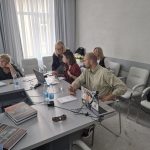
- Debra Brunner with Sonia Shaipak and Vasily Zaitsau from The Together Plan team Photo credit: Neil Adams
-
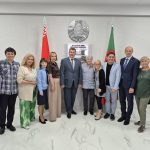
- Delegates at the symposium Photo credit: Neil Adams
-
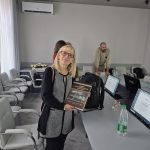
- Debra Brunner is presented with a book ‘Genocide of the Belarusian People’ by the Prosecutors Office Photo credit: Neil Adams
-
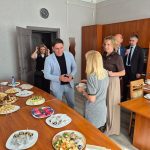
- A warm reception for the symposium delegates Photo credit:: Neil Adams
The town is also famous for the heroic escape of approximately 235 Jewish prisoners who escaped from the Novogrudok labour camp. The tunnel that the Jews dug was 200 meters long, which became the longest tunnel escape of World War 2. Of the 126 who escaped many managed to reach the Bielski partisans in the forests. These types of stories are what make the story of Novogrudok unique but at the same time are representative of the horrors of the Holocaust in Belarus and of the heroic acts of resistance that took place throughout the country. Novogrudok, like countless places in Belarus, had hundreds of years of Jewish history and culture that was wiped out during the Holocaust. This history and heritage will also have a central place in the new Museum as will the relevance of the lessons that we can learn as the world is faced with fresh waves of antisemitism and other forms of division and hatred.
These stories need to be told and finally the journey to tell them has begun to ensure that Belarus will take its rightful place in global narratives about the Holocaust and resistance. Watch this space!