
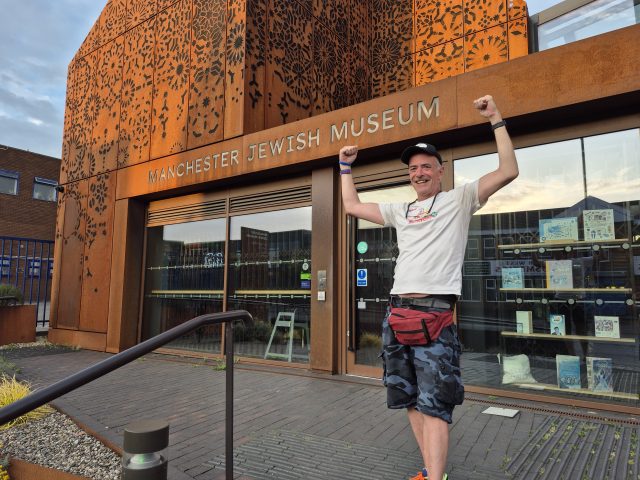
An extremely happy me.
By Neil Adams, Fundraising and Education Research Coordinator at The Together Plan
My fascination with Eastern Europe dates back to the mid-1990s when, in a former life, I was an urban and regional planning consultant based in Brussels and we became involved in capacity building projects supporting Latvia and Lithuania as they started their journey towards EU membership, which they finally achieved in 2004. On my return to the UK in 2005 I moved into academia and spent 20 years teaching urban and regional planning and participating in research projects, always with a focus on Central and Eastern Europe. I was just totally fascinated by these places that I realised I knew so little about after they were hidden from my “Western” eyes for half a century behind an Iron Curtain.
In the course of my thirst for knowledge about the history of this part of the world I became increasingly curious about this mysterious place called Belarus. I had long been fascinated by War and Holocaust history but like many in the collective west I tended to equate the Holocaust with Auschwitz and the camps and ghettos of Nazi occupied Poland. When I got the opportunity to volunteer in orphanages and at summer camps in Belarus with an amazing charity Chernobyl Children’s Project UK I jumped at the chance. Over the course of a few visits and the acquisition of numerous books I started to explore the Holocaust in the East and came across the activities of the Together Plan and I was immediately hooked.
The topic, the geographical focus and also the mission and ethos of the Together Plan preserving memory, promoting education and supporting local communities aligned perfectly with my rapidly developing fascination. I also loved the focus on the Holocaust in the East, beyond Auschwitz that tends to dominate Holocaust consciousness in the collective West. I firmly believe that not only do these stories need to be told to an English speaking audience, but that it is also impossible to situate knowledge about the rest of the Holocaust without some understanding about the atrocities in the former Soviet Union and particularly Belarus.
After exploring the Jewish history of the town where the orphanage was located (Rechitsa in the Gomel region in south-eastern Belarus) I wrote a short blog about my experience. I continued to follow the activities of the Together Plan closely and decided that I had had enough of Higher Education after 20 years and retired in September 2024. This provided me with the time, the head space and the opportunity to pursue my passion and I became a Volunteer. My previous professional experiences and skills in relation to urban and regional development, education and seeking funding for projects could also be applied to the activities of the Together Plan. I also realised very quickly that I could not really research the Holocaust in the East effectively without a knowledge of the broader context of Jewish history and heritage in that part of the world. Not being Jewish myself this was a bit daunting and to be honest quite scary! That is still a work in progress but luckily with great support from the Together Plan family and a lot of reading and research I am getting more involved and loving every minute and learning a huge amount!
In June 2025 volunteers and supporters of the Together Plan embarked on a Walkathon to raise money to complete the historically important Brest-Litovsk Memorial Project, the first of its kind in Belarus. As the Together Plan has volunteers and supporters all over the world, people walked wherever they are located and chose the distance that they wanted to walk, so people in a range of countries including UK, Belarus, USA and Greece participated.
Through my own research and my work with the Together Plan I realised that I knew a fair bit about Holocaust history and Jewish heritage in Belarus, the Baltic states and Poland but virtually nothing about this history and heritage where I live in Greater Manchester. So, to try to start to fill this gap in my knowledge I designed my walking route to explore various Jewish sites around Manchester. The focus of the Together Plan on Belarus is not as distant to the Jewish communities of Greater Manchester as it may initially seem. As Belarus was at the heart of the Pale of Settlement and following the various mass migrations and the atrocities of the Holocaust, countless members of the Jewish diaspora (including those in Greater Manchester) can trace their heritage back to Belarus.
My route included 9 stop off points and was 27.73 miles in total, trust me to pick the warmest day in living memory to do it!! Luckily my previous experience of running marathons meant that I was well prepared with energy gels, hydration powder and copious amounts of water and even more copious amount of Haribos to keep my hydration and energy levels up!
The route included stop off points at:
- Warth Mills Bury
- Whitefield Jewish Cemetery
- Old Jewish Cemetery Prestwich
- Rainsough Jewish Cemetery Prestwich
- Agecroft Jewish Cemetery Pendelbury
- Pendleton former Jewish Burial Ground Salford
- Manchester New Synagogue Urmston
- Southern Cemetery Chorlton
- Manchester Jewish Museum Cheetham Hill
-
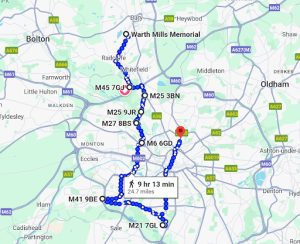
- Route though Manchester
My training went pretty well and I enjoyed getting out and about in nature and along the canal network around Wigan where I live. The walk itself was slightly different in that it was predominantly urban, although still included a huge diversity of urban and semi-rural landscapes ranging from natural, industrial, residential and suburban, city centre and the glitzy environments around Media City and Salford Quays.
I thoroughly enjoyed exploring the sites, some large ones. The cemeteries and memorials at Agecroft, Rainsough and the Southern Cemetery were particularly impressive although my personal favourite was the tiny Pendleton former Jewish Burial Ground, the first dedicated Jewish burial site in Greater Manchester. I have always liked the layout of cemeteries (Jewish and non-Jewish) in Eastern Europe that have the feel of a park rather than the bland cemeteries we often have in the UK. I was pleased to see that some of the sites I visited also had this park feel, particularly the huge Southern Cemetery where families were walking, cycling and generally just relaxing. This brings a cemetery to life and makes it much more than just a place of sorrow.
-
- Jewish Burial Ground in Greater Manchester in Pendleton (measuring 12m by 11m). Image credit: Neil Adams
-
- The impressive Jewish section in the huge multi-faith Southern Cemetery in Chorlton. Image credit: Neil Adams
I was struck by the huge difference in scale between the tiny first dedicated Jewish Burial Ground in Greater Manchester in Pendleton (measuring 12m by 11m) and the impressive Jewish section in the huge multi-faith Southern Cemetery in Chorlton.
My walk started at the Warth Mills Memorial, siter of one of the largest internment camps in Britain, created in 1940 to house up to 2000 mostly Italians and Nazi sympathiser but also some Jewish refugees. The Mill is long gone but there is a small poignant memorial at the site. Conditions for the internees were apparently pretty appalling with prisoners sleeping on the floor between old machinery, glass and oil in a building lacking windows and open to the elements.
-
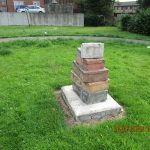
- Small memorial at the site of the former internment camp at Warth Mills in Bury. Image credit: Neil Adams
There was also little sanitation and food rations were meagre. Interestingly the Manchester Group of the Genealogical Society of Great Britain worked on the project to document the history of the camp and there is an ongoing project to identify the ordinary Jews who passed through the camp. Although information is available on some of the well-known Jewish artists, intellectuals and academics interned at the camp, there is no list of the less well-known prisoners.
Among the more well-known Jewish internees at the camp were Kurt Schwitters and Hellmuth Weissenborn (artists) and Peter Gellhorn (musician and opera director).
Leaving Bury I headed south through a cluster of Jewish cemeteries in close proximity to each other to the north and west of Manchester in Whitefield, Prestwich, Rainsough, Pendleton and Salford. This cluster presumably reflects the places where significant Jewish populations settled from the late 18th century onwards.
Some of these cemeteries are historical sites that are now closed such as Whitefield (first burial 1857 and last burial 1992) and the Old Jewish Cemetery in Prestwich (opened in 1841 with the last burial in 1914). The walk to Whitefield Jewish Cemetery (also known as Philips Park Jewish Cemetery) took me through some lovely countryside and the Cemetery itself is in a tranquil semi-rural setting and is open and accessible. The existing Cemetery is no longer used for burials although apparently a planning application was submitted in 2024 for a new burial ground on adjacent land. I need to do a bit more research to find out about the status of this planning application, but as a planner by profession, I cannot see any valid planning reasons why such a proposal would not be approved in this location.
-
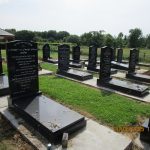
- Whitefield Cemetery with the Eliot Levy Ohel in the background. Image credit: Neil Adams
-
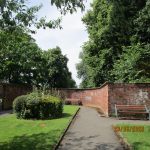
- High perimeter wall closes off access to and views of the Old Jewish Cemetery in the centre of Prestwich. Image credit: Neil Adams
The walk from Whitefield to the Old Jewish Cemetery in Prestwich saw a transition from a semi-rural to a much more urban landscape. The walk started in tranquil surroundings before the tranquillity was destroyed by crossing the M60 motorway after which the landscape was much more urban through the centre of Prestwich. The Old Jewish Cemetery in Prestwich opened in 1841 and is the second oldest Jewish Burial Ground in Greater Manchester. After the last burial in 1914 the site was finally closed to the public in 1951, when a Garden of Rest was created in front of the site for the Festival of Britain. The site contains between 300-500 graves but unfortunately the high perimeter wall prevents both access to and views of the site and the impressive array of headstones within it. From a purely urban planning perspective this is a great pity as having at least views of the site would add significantly to the quality of the urban fabric in this central location.
The walk from the site in Prestwich to Rainsough Jewish Cemetery started along a wonderfully serene path through a woodlands cemetery and park before transitioning into suburbia. The Cemetery is located in the urban fringe close to the River Irwell. The site is under the management of the North Manchester Jewish Cemeteries Trust who have a presence on site and maintenance and landscaping works were taking place. The large and impressive site was acquired in 1923 by Manchester Central Synagogue, is open and accessible and is still in use. There is also a Memorial to Jewish soldiers from World War 2 buried in this Cemetery and also includes names of Jewish soldiers from World Wars 1 and 2 buried in various Jewish cemeteries (or Jewish sections of cemeteries) around Manchester, some of which I visited (Whitefield, Urmston and Southern Cemetery). I have now added the others to my list of places to visit (Blackley, Failsworth, Crumpsall and Eastlands).
The large and impressive Rainsough Jewish Cemetery also has a Holocaust Memorial listing numerous sites of mass murder throughout Europe, although unfortunately Minsk and other death sites in Belarus are not mentioned. Another indication of the lack of recognition and consciousness about the Holocaust in Belarus prevalent in Western Europe, which makes the mission of the Together Plan to tell these stories all the more important!
-
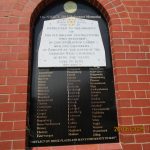
- Holocaust Memorial and Memorial to Jewish soldiers from both World Wars buried at Rainsough and other Jewish cemeteries around Manchester. Image credit: Neil Adams
-
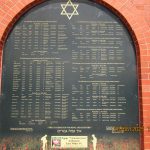
- Holocaust Memorial and Memorial to Jewish soldiers from both World Wars buried at Rainsough and other Jewish cemeteries around Manchester. Image credit: Neil Adams
My route from Rainsough to the next site at Agecroft Jewish Cemetery took me through the picturesque Drinkwater Park and over the River Irwell. The site was locked and a pass code was required to enter. Thinking I did not really have time to ring the number given to get the code I was just about to leave when a lovely lady who knew the code came and let me in. Accessing the site was well worth it with some impressive headstones and a small Holocaust Memorial that lists over 60 death sites, although once again unfortunately Minsk and Belarus seem to have been neglected. The Cemetery was opened in 1972 and is still operating as a cemetery today. The inscription on the Holocaust Memorial reads:
“Dedicated to the everlasting and cherished memory of the souls of 6 million Jewish martyrs, the innocent men, women and children who were slaughtered with unparalleled cruelty during the Nazi Holocaust. Our people and mankind must never forget them”.
-
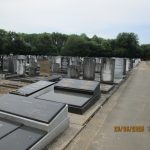
- Large and impressive Agecroft Jewish Cemetery and Holocaust Memorial. Image credit: Neil Adams
-
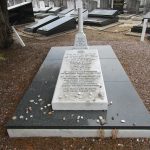
- Large and impressive Agecroft Jewish Cemetery and Holocaust Memorial. Image credit: Neil Adams
Sadly, the walk from Agecroft to Pendleton former Jewish Burial Ground was less picturesque, passing through a combination of industrial and suburban residential areas. The site was the first dedicated Jewish burial ground in Greater Manchester, established for the Old Hebrew Congregation in 1794 until it’s closure in 1840. The small rectangular plot measure 12m by 11m and contains 29 graves although only a few of the headstones are still visible arranged in the form of a star. There is a small information board at the site that also provides very brief details about the people buried there.
-
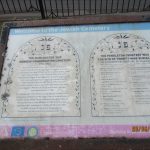
- Information board at Pendleton Jewish cemetery with details of the 29 people buried here. Image credit: Neil Adams
-
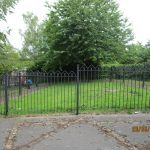
- Pendleton Jewish cemetery – a tiny rectangular plot. Image credit: Neil Adams
There was an information board at Pendleton with details of the 29 people buried here on this tiny rectangular plot. Being a lover of historical oddities, this site located in a small park sandwiched between industrial units and the busy A6 road was the highlight of the day for me!
The short distance between the cluster of sites to the north and west of Manchester now became a thing of the past as I moved towards the south of the city to the Manchester New Synagogue Burial Ground in Urmston. From now on it was over 5 miles between each of the remaining 3 stopping points. The walk to Urmston was distinctly urban, although nevertheless transitioning from suburbia, through some rather colourful but definitely urban subways under major roads, into the glitzy environment of Media City and Salford Quays, then the industrial sites of Trafford and back into the suburbia of Urmston.
On arrival at the Urmston site, I was once again confronted with a locked gate requiring a pass code to enter. Just as I was about to leave for the next site I thought……… I wonder if the code is the same as the code at Agecroft, and low and behold it was! Never underestimate the resourcefulness of the Together Plan when it comes to accessing and exploring Jewish sites! Unlike the vast majority of other sites, I encountered other explorers here, a man working on a book about 4 cemeteries in Manchester and his guide. The brief chat that I had with them confirmed my findings from my rather superficial research beforehand that the history of divisions and splits between the various Manchester congregations over the years were highly complex and well beyond my understanding! I was pleased to find a small memorial to Jewish soldiers of World Wars 1 and 2 with inscriptions in Hebrew and English as well as some impressive gravestones in this large site.
-
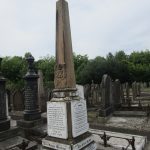
- War memorial at the Manchester New Synagogue Burial Ground. Image credit: Neil Adams
-
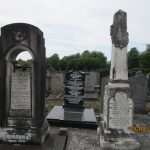
- Some impressive headstones at the Manchester New Synagogue Burial Ground. Image credit: Neil Adams
Now it was time to head 5 miles east through Stretford to the Southern Cemetery in Chorlton-cum-Hardy, again an extremely urban landscape with a few rather colourful and interesting subways. However, I did learn that Chorlton seems to be an interesting place if you like food with numerous small bars and eateries that by this time in my walk were extremely tempting! I managed to resist the temptation, turning instead to the last of my by now sad looking, squashed and rather unappetising cottage cheese rolls that I had brought with me. Luckily, I still had some Haribos left for desert!
The Southern Cemetery is apparently the largest Municipal Cemetery in the UK and the second largest in Europe and I can confirm that it is huge! The scale of the site was confirmed when I walked from the Jewish section in the south-west corner of the site, with numerous extremely impressive headstones, to the site of the Memorial to the Katyn massacre commemorating the approximately 22,000 Polish military and intelligentsia murdered by Stalin’s secret Police the NKVD in 1940, which was at the opposite side of the Cemetery. The Jewish section initially served the Manchester Reform Synagogue from 1892 onwards and is still in use. The site also has protected status as a Grade 2* Registered Park and Garden.
The cemetery is a multi-faith cemetery and is divided into sections according to faith and nationality with a large Polish section reflecting the large Polish population of Manchester. There are also various sections dedicated to British and Polish soldiers and airmen from both World Wars.
-
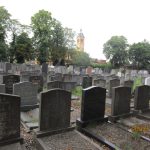
- Large and impressive Jewish section at the huge Southern Cemetery. Image caption: Neil Adams
-
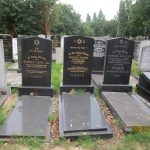
- Large and impressive Jewish section at the huge Southern Cemetery. Image caption: Neil Adams
-
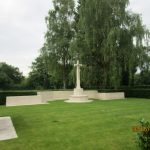
- Memorials to British and Polish soldiers and airmen fallen in both World Wars and to the victims of the Katyn Massacre in 1940. Image caption: Neil Adams
-
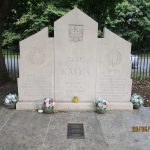
- Memorials to British and Polish soldiers and airmen fallen in both World Wars and to the victims of the Katyn Massacre in 1940. Image caption: Neil Adams
The final leg of the walk was the long trek from Chorlton in the south, right though the city-centre up to the finishing line at the Jewish Museum in Cheetham Hill to the north of the city. A route of over 5 miles, most of which is along the extremely busy Princes Road, this bit was hard work! The monotony of walking along a busy dual carriageway was finally broken when I arrived in the city centre as I continued to head north. There were lots of people out and about enjoying the sunshine in the bars and eateries. Finally, I reached Manchester Victoria Station and I knew it wasn’t much further. Cheetham Hill has traditionally had a highly diverse population including a large Jewish representation and the further you go from the city this is reflected in the presence of Jewish shops, schools and synagogues.
The Museum was established in 1984 and is housed in a Grade II* listed 1874 (former) Spanish and Portuguese synagogue. The Museum underwent an extensive redevelopment and extension in 2021 and now includes a new gallery, vegetarian café, shop and learning studio, and the Synagogue was completely restored at the same time. I have visited the excellent Museum previously but unfortunately as it was 9.30 in the evening by the time I got there and the Museum was already long closed. So there was I feeling extremely pleased with myself and delighted to have completed my Walkathon but I did feel a bit like Billy no mates as I sat on my own smoking the cigarettes I had been looking forward to all day. I even had to accost a random passer-by to take my finishing line photos! Luckily Debra and Artur (co-founders of The Together Plan) were on hand for a video call before I headed back to Victoria Station to make my way home to Wigan. Typically, I arrived at the station just as a train was about to depart but I quickly decided to wait for the next one as there was no way my legs were capable of running to catch this one!
Overall, it was a thoroughly enjoyable day and experience and I learned a lot. However as with all such experiences I have ended up with more questions that I now need to research. But that is how we learn. It was a privilege to be able to make a small contribution to this incredible and historically important project for the Brest-Litovsk Memorial and it will be an even greater privilege to attend the opening ceremony in Belarus. Suffice to say I am already getting massively excited!!
I hope that you have enjoyed my report on my brief exploration of a part of Jewish Manchester. Clearly I still have much to learn!
-
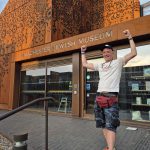
- An extremely happy me.
-
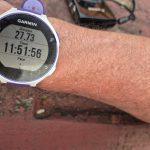
- My almost out of battery Garmin watch at the finishing line. Image credit: Neil Adams
If you would like to sponsor Neil for his incredible 27.73 mile walk in support of the historic memorial being built at the site of the Brest-Litovsk Jewish cemetery in the south of Belarus, just click here.
And if you would like to know more about Neil’s walk – please get in touch – [email protected]
For more information about the Brest-Litovsk Jewish cemetery memorial – click here