
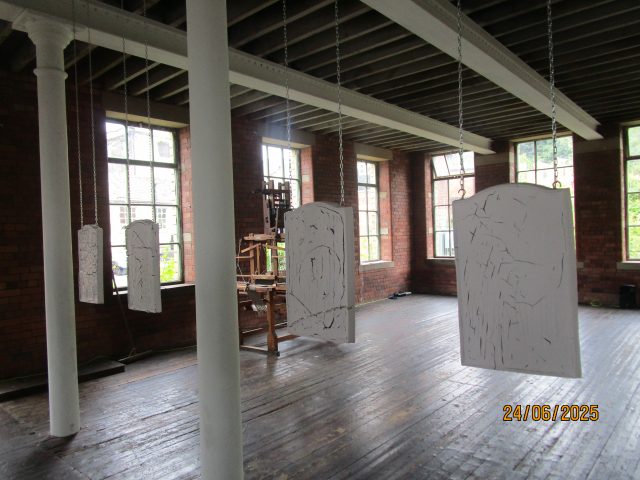
Archaeology of Absence by Irina Razumovskaya. Image credit: Neil Adams
By Neil Adams, Fundraising and Education Research Coordinator at The Together Plan
I did not really know a lot about the Holocaust Centre North (HCN), based at the University of Huddersfield, apart from the fact that they existed and primarily focused on Jewish refugees who fled antisemitism in Central Europe on the eve of the Holocaust to settle in the beautiful County of Yorkshire. It must have been a bit of a culture shock to say the least! I live in Wigan on the right side of the Pennines and even I find Yorkshire a little strange so it must have been something of a culture shock to refugees arriving from Germany, Austria, Czechoslovakia and Poland, some via the Kindertransport operation whereby approximately 10,000 Jewish children came to Great Britain mainly in 1938-1939.
I have been a volunteer with the Together Plan since February 2025 taking on the role of Fund Raising and Education Research Coordinator. Not being Jewish myself this presents quite a challenge. I have a long standing fascination in the history of Eastern Europe and the former Soviet Union from my roles in my previous life as an urban and regional planner and as an academic. Through my work I came to learn about the importance of Jewish heritage and Holocaust history in this part of the world.
One part of my role at The Together Plan is to strengthen our network here in the North of England with individuals and organisations with whom we share interests and with whom we have a similar ethos and approach. Since starting my volunteer role I quickly realised that there are synergies left, right and centre in terms of what both the Together Plan and the HCN do and it soon became clear that HCN were an organisation that it was important to engage with.
Studying their excellent website was a revelation in terms of both structure and in terms of the nature, quality and amount of content. Like The Together Plan. they are a charity concerned with disseminating information, generating knowledge and promoting learning about the Holocaust primarily by focusing on local stories. Their local stories obviously focus on Yorkshire and the North of England whereas ours focus primarily on Belarus and people with ancestral connections to the country, but the idea is the same. We both do this to stimulate dialogue about the Holocaust at a human level, one that is easier for people to relate to than global statistics about the murder of 6 million Jews.
Alongside the excellent permanent exhibition, HCN is committed to delivering high quality and academically rigorous Holocaust Education and research, organising school visits, hosting talks and telling stories to give a voice to survivors and refugees, to preserve memory and to educate current and future generations. They offer learning programmes for primary and secondary age students as well as for adults and they organise Holocaust Study Days. Another parallel with the Together Plan is that HCN is also committed to applying these lessons to modern day situations and events in order to promote learning and understanding and to fight against antisemitism and other forms of hate and division. They have a strong focus on supporting local communities, as we do with our communities in Belarus.
The complex history of Jewish life in Belarus means that many Jewish families around the world — including those in the North of England — can trace their roots back to the territories of the former Soviet Union. Yet, due to shifting borders, mass migrations, and the devastating impact of the Holocaust, these ancestral connections are often obscured or lost. At The Together Plan, we are dedicated to helping individuals reconnect with this hidden past through our archival work and ancestry research services, shining a light on stories that have long been buried.
My online search revealed that HCN was hosting a temporary exhibition “Memorial Gestures” that explored aspects of the Holocaust through artworks as part of their innovative artists in residence programme. The temporary exhibition was running for the whole of June so I decided to combine a visit to the permanent exhibition with a visit to Memorial Gestures towards the end of the month.
I had contact with a couple of people from HCN who advised me that as I was travelling over the Pennines from Wigan by train it made sense to visit the permanent exhibition first at the University of Huddersfield and then to jump back on a train to New Pudsey which would get me to Sunny Bank Mills in Farsley where I could visit Memorial Gestures. The first surprise of the day was that the train actually turned up in Wigan and I was on my way. Anyone who has to use trains in the north of England will understand my surprise!
Holocaust Centre North began in 1995 as the Holocaust Survivors’ Friendship Association, created to offer support and a safe space for Holocaust survivors and refugees who had resettled in Yorkshire — some fleeing the Nazis in the 1930s, others arriving during or after the Holocaust. It became a place where survivors could meet, talk, and share their experiences, often for the first time. This mirrors the work of The Together Plan, which creates similar spaces for survivor communities in Belarus, fostering connection, healing, and the sharing of long-silenced stories.
Since becoming a registered charity, Holocaust Centre North has established itself as a vital centre for learning and research in the North of England. Although housed within the University of Huddersfield, it operates independently while maintaining a close, symbiotic relationship with the University. Several University academics are actively involved in HCN’s research, education, and programming, and in turn, HCN serves as a valuable resource for students — particularly those enrolled in the MA in Holocaust and Genocide Studies. This partnership ensures not only academic collaboration but also the scholarly integrity and thoughtful presentation of HCN’s collections and narratives.
After a short, pleasant walk through the streets of Huddersfield, I arrived at the Schwann Building on the University campus and was warmly welcomed by HCN archivist Hari and Michael, one of Holocaust Centre North’s enthusiastic and knowledgeable volunteers. Michael kindly offered to guide me through the exhibition, sharing valuable insights into both the displays and the history of HCN itself. The collection is deeply moving, comprising over 110 survivor testimonies, along with personal papers, artefacts, photographs, and both audio and filmed accounts — each one a powerful window into individual stories of survival and resilience.
Many of the items in the collection have been generously donated by refugees and their families, drawn from personal and family archives that, in some cases, trace their histories as far back as the 1880s. The archivists at Holocaust Centre North are actively cataloguing and digitising the collection — a vital part of their Homeward Bound programme — to both preserve these precious materials and make them more accessible to researchers and the wider public through remote access.
As with any collection, there’s something uniquely powerful about seeing — and in some cases, even touching — the exhibits in person. The exhibition centres around the stories of 16 individuals who either escaped or survived the Holocaust and went on to build new lives in the North of England. At the entrance, visitors are greeted by photographs of all 16, inviting us to experience the unfolding history through their eyes. My knowledgeable guide, Michael, generously shared stories from their lives, adding depth and personal context to the displays. The diversity of their experiences — from those who arrived in England before the war, to others who endured concentration camps, forced labour, or displacement and came during or after the conflict — offers a compelling and multifaceted perspective on survival, resilience, and rebuilding.
The exhibition is organised thematically, guiding visitors through the key events beginning with the rise of the Nazis in Germany. The progression of antisemitic laws and growing oppression is powerfully illustrated by exhibits such as a replica bench bearing the chilling sign “Only for Jews.” Informational panels trace the steady escalation of persecution, culminating in the horrors of Kristallnacht on November 9-10 1938 — a violent pogrom that served as a final warning for many Jews, prompting those who could to flee Germany in search of safety.
-
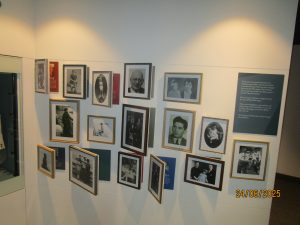
- The 16 refugees who resettled in the North of England and around whom the exhibition is based. Image credit: Neil Adams
-
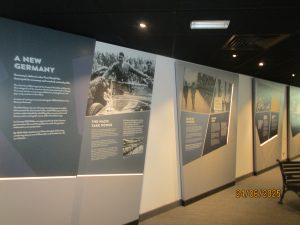
- Informative information boards organised thematically. Image credit Neil Adams
Each of the information panels has a quote from one of the survivors, which adds a further personal and authentic touch to the collection. Many of the escapees were interned in camps across the country and one of the quotes by refugee Heinz Skyte captures the irony as well as the horror of what some of the new arrivals experienced when they came to Britain:
“In Germany we were kicked out because we were Jews, here we were interned because we were Germans…..”
The exhibition includes a number of thoughtful interactive and animated audio-visual displays, along with a powerful 12-minute film shown in a small cinema space. The film explores themes such as barbarity, degradation, escape, despair, and the journey to survival. I was particularly struck by Holocaust Centre North’s sensitive approach: the exhibition avoids relying on graphic imagery to convey the horrors of the Holocaust. Instead, it focuses on personal stories and nuanced interpretation — an ethos closely aligned with that of The Together Plan. Like HCN, we believe that impactful Holocaust education can be achieved without resorting to shock tactics, often resulting in a more meaningful and lasting impression.
There is a small section focusing on the occupations in the west and in the east although the focus on the East only examines Poland. I was pleased to see that there was a section on the invasion of the Soviet Union and the Holocaust in the East with information about the Einsatzgruppen or mobile killing squads who were actively involved in the murder of a significant proportion of the 2.7 million Jews killed in the occupied territories of the Soviet Union.
The exhibition also includes information about the Kaunas Ghetto in Lithuania, featuring powerful quotes from a survivor who reflects not only on the atrocities themselves, but on the unsettling reality that many were carried out not by sadists or psychopaths, but by ordinary people for whom mass murder had become normalised. It serves as a stark reminder that, without education and vigilance, such horrors can — and have — happened again in various parts of the world since the Holocaust.
-
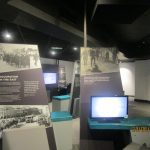
- Mixture of information boards and interactive and animated exhibits. Image credit: Neil Adams
-
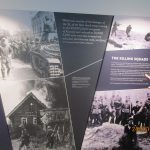
- Section on the Holocaust in the East. Image credit: Neil Adams
There are a number of other themes covered including the ghettos, death camps, resistance, death marches, liberation, post-war justice (or lack of it) and the complexities of life after the Holocaust as the refugees started to try to start new lives in the North of England. These refugees often had to do this with the knowledge that their families and former homes and communities had been wiped out and now only existed in memory.
The scale and nature of the Holocaust obviously mean that the precise resting place of the vast majority of victims is unknown and I therefore found the digital memorial where families from the North of England can remember loved ones and family members particularly poignant. You are able to search by name and access photographs and other information, a wonderful resource. The simple thoughts board with stick on notes from visitors also provides and insightful record of how the exhibition is experienced and the exhibition was rounded off on my visit by an informative portable exhibition in the foyer.
-
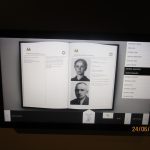
- Digital Memorial to the Victims. Image credit: Neil Adams
-
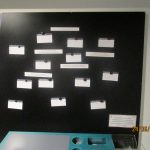
- Thoughts board a simple way to record visitor experiences. Image credit: Neil Adams
I thoroughly enjoyed my visit to the permanent exhibition and am already looking forward to returning soon for a meeting with members of the HCN team. The museum is compact and can comfortably be explored in an hour or two — or longer, if you choose to engage fully with the many powerful audio-visual testimonies. The layout is clear and intuitive, and the decision to centre the exhibition around the diverse experiences of 16 individuals who settled in the North of England brings the history to a deeply personal and relatable level.
The presentation strikes a thoughtful balance between traditional and modern approaches: informative display boards (featuring moving quotes from refugees) are complemented by interactive multimedia and audio-visual content. The result is a clear, coherent, and impactful narrative that communicates the key messages with both sensitivity and strength. I would highly recommend a visit.
After a final chat with Hari and Michael I made my way back to the train station and headed for New Pudsey to visit the Memorial Gestures exhibition. After a 10-15 minute wander through the extremely pleasant village of Farsley I arrived at the imposing and historic Sunny Bank Mills. The former mill houses numerous activities as well as the exhibition space where Memorial Gestures was hosted.
Here I met Mohammed another member of the HCN archives team. Mohammed impressed me with his knowledge of the Holocaust in the East and showed great interest in the activities of the Together Plan. There are 18 artworks exhibited in a wonderful atmospheric space in one of the former mill buildings. The historical setting fits perfectly with the historical nature of the topic. There are also a couple of books of stories and poetry that form part of the exhibition which are available to buy.
The collection is made up of artists who have drawn on their own life experiences as the grandchildren of Holocaust survivors, refugees or members of minorities who have been discriminated against. Each piece reflects the unique nature of each survivor and refugee story. The artworks are highly diverse and use a combination of films, photographs, etchings, display tables, sculptures and different types of structures in a range of materials; extracts from letters, tapestries and textiles, books, documents and one in particular has a background of melancholic music with layers of sound. Each piece conveys its message about remembrance, trauma, loss and hope in a unique and thought-provoking way.
I cannot do justice to the artists or to the individual artworks so I would refer you to the HCN website if that is what you are looking for. I must admit that I am far from an art expert and some of the pieces were a little too abstract for me. Culture to me is going to watch my beloved Walsall FC and getting a takeaway on the way home! But to quote Paula Kolar the Curator of Contemporary Practices at the HCN:
“……….Some artworks in this exhibition might speak to you more directly than others – they are after all highly personal and subjective reflections.”
Paula Kolar, Memorial Gestures Brochure and Guide
The pieces that spoke to me the most included “Archaeology of Absence” by Irina Razumovskaya which consists of a series of suspended porcelain slabs representing window frames reflecting contrasting worlds of sanitised spaces and windows with cracks and scratches from despairing hands.
Two ceramic hands mounted on steel structures called “Aching” by Maud Haya-Baviera also had an impact on me in the way that the hands are trying to touch but remain separate. One of the hands appears to be bleeding. I also found “A Glimpse at the Abyss” by Chebo Roitter Pavez a powerful piece. The work consists of a number of tapestries depicting antisemitism through the ages, the spread of Nazi ideology and the increasing discrimination, violence and persecution experienced by Jewish communities across Europe.
-
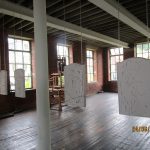
- Archaeology of Absence by Irina Razumovskaya. Image credit: Neil Adams
-
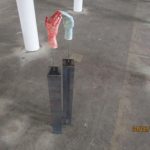
- Aching by Maud Haya-Baviera. Image credit: Neil Adams
The most informative, insightful and easiest to understand piece for me was “These Were Not Simple Deaths” by Jordan Baseman that consists of a 20-minute film of an interview with the late Lilian Black OBE. Lilian served as the Chair of the Holocaust Survivors Friendship Association and was one of the driving forces behind the establishment of the HCN. She was also the daughter of a survivor, Eugene Black, who was eventually liberated from Bergen-Belsen after experiencing the horrors of forced labour at Auschwitz-Birkenau. Like many survivors Eugene did not talk about his experiences when Lilian was a child. She refers to it as the unspoken silence of the Holocaust, a silence with which survivors of the Minsk Ghetto and many others are also familiar. Later in life they visited both Bergen-Belsen and Auschwitz together and with the help of the archivists there managed to access his camp documents and records in what must have been an incredibly difficult and emotional journey. Lilian’s insights into her own experiences as a child and her father’s experiences as a prisoner are hugely insightful and powerful.
I thoroughly enjoyed the exhibition, even if I am something of a philistine when it comes to art! All of the installations triggered something in my mind and my emotions, some more than others. An exhibition such as this is clearly reason enough to demonstrate the value of HCN’s innovative artists in residence programme. I have a friend who does outreach work in schools in Greater Manchester where she works with students to explore the Holocaust through art. I strongly believe that the more mediums that we can use to explore the Holocaust the better.
Overall, I thoroughly enjoyed my day in Yorkshire. I met some interesting and knowledgeable people, visited an excellent Holocaust exhibition and explored the Holocaust through a medium that was a little out of my comfort zone. These experiences were insightful and inspiring, raising new questions in my mind that I now need to go away and research. If people and exhibitions can do that then in my opinion it is an experience worth having. I am looking forward to meeting more of the HCN team so that we can discuss these issues in more detail. I would thoroughly recommend anybody interested in the Holocaust to visit the permanent exhibition.
Neil Adams
Fund raising and Education Research Coordinator
The Together Plan
[email protected]
8th July 2025