
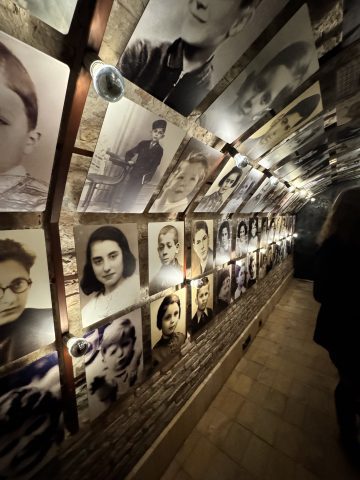
Jewish Museum, Brussels
Crossing four borders and travelling for two days to get there, Artur Livshyts, our co-founder and Belarus Country Director, participated in an important international seminar in Brussels this month, which focused on the marking and memorialisation of Holocaust sites across Europe. The conference forms part of a collaborative project addressing a pressing and sensitive question: How should decisions be made about which Holocaust sites ought to be marked with plaques or memorials?
Coordinated by FestivAlt (Poland), the seminar brought together experts from more than 15 EU countries, including historians and cultural heritage professionals. Distinguished participants included Katharina von Schnurbein, the European Commission Coordinator on Combating Antisemitism and Fostering Jewish Life; Victor Sorensson, Director of the AEPJ (European Association for the Preservation and Promotion of Jewish Heritage); and representatives from both IHRA and Yad Vashem. Artur Livshyts was invited to contribute to the project as the representative for Belarus.
The seminar provided a platform for in-depth discussion on the criteria and ethical considerations involved in selecting sites for commemoration. Participants explored factors such as historical significance, community engagement, visibility, and educational impact.
Particular attention was given to the profoundly complex issue of Jewish cemeteries that became killing sites during the Holocaust. These places bear a dual and solemn significance: they are sacred spaces of eternal rest that were violently desecrated, and they also serve as the final resting places of victims murdered in mass executions. Marking such sites demands exceptional sensitivity to honour both the sanctity of the cemetery and the tragedy of the atrocities committed there.
-
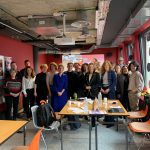
- Conference delegates
-

- Jewish Museum, Brussels
-
- Jewish Museum, Brussels
-
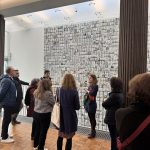
- Jewish Museum, Brussels
As an active contributor, Artur Livshyts emphasised the importance of inclusive, locally informed approaches. He highlighted the need to involve descendants, local historians, and Jewish communities to ensure that commemoration efforts reflect both historical accuracy and collective memory.
The seminar also examined practical considerations regarding plaque installation, including materials, multilingual inscriptions, QR codes for digital context, and long-term maintenance, to ensure that markers function not only as memorials but also as educational tools for future generations.
This gathering represented a meaningful step toward a coordinated European effort to preserve Holocaust memory through thoughtful and respectful site marking. Although none of the Holocaust sites in Belarus can be considered to be marked under the framework of this project, we are nevertheless proud that, through this initiative, the historical importance of Belarus’s Jewish history, heritage and Holocaust narrative is being recognised in this important field, and Artur Livshyts was honoured to have the opportunity to contribute to discussions within a domain that remains profoundly challenging and deeply significant.
On his way back to Minsk, Artur diverted to the UK for a few days for meetings with the UK team and then made his way back to Belarus (where the snow was awaiting him) – another 48 hours negotiating more borders, long drives and hours of waiting. Patience and determination are two skills Artur has perfected and he knows and understands all too well that they are key drivers to ensuring we reach our goals…. along with good Wi-Fi and a warm coat!
J