
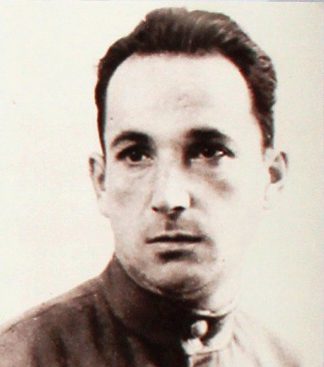
Alexander Pechersky Photo credit: Poeticbent, CC BY-SA 4.0 creativecommons.org via Wikimedia Commons
By Neil Adams
Introduction
Alexander ‘Sasha’ Pechersky was a Red Army soldier who led the largest mass escape from a Nazi death camp in World War 2, or the Great Patriotic War as it was known in the former Soviet Union. The events have been immortalised in various documentaries and perhaps most famously in two films, ‘Escape from Sobibor’ (1987) where Rutger Hauer played the role of Pechersky and more recently in a film simply called ‘Sobibor’ directed by and starring Konstantin Khabensky in 2018.
Sobibor in Eastern Poland was the second death camp established as part of Operation Reinhard and operated from May 1942 until December 1943 and although estimates vary it is thought that up to 250,00 Jews were murdered there. The most recent estimates have reduced this figure to approximately 180,000 although the nature of the death camps and the absence of reliable records mean that it is impossible to estimate with any certainty. The first Operation Reinhard death camp was Belzec, also in Eastern Poland, established in March 1942 and liquidated in June 1943 (estimated 430,000 – 500,000 Jews murdered). The final and most deadly camp was established to the north-east of Warsaw at Treblinka, established in July 1942 and liquidated in October 1943 with between 800,000 -925,000 victims. In terms of numbers of victims therefore the Operation Reinhard camps were responsible for more murders than Auschwitz.
Operation Reinhard was named after Reinhard Heydrich, a high-ranking SS officer and one of the key architects of the Holocaust who was assassinated by Czech operatives in May 1942. The primary aim of Operation Reinhard was to annihilate Polish Jewry although Jews from other parts of Europe including the Netherlands, Slovakia, Austria and from places further east such as Minsk were also murdered in these camps. The camps were different to many other Nazi camps in that they were purely death camps with only a skeleton cadre of Jews kept alive to facilitate the murder process, sort property stolen from Jewish victims and manufacture some goods to support the German war effort. The handling and manufacture of goods combined with the greed of the SS officers is central to the story of the Sobibor uprising as we shall see. The sites were specifically selected due to their remote location in dense forests and proximity to railway lines.
Alexander Pechersky was only imprisoned in Sobibor for a matter of weeks but the impact that his presence had is potentially one of the most heroic stories of the War. Although Pechersky was from Ukraine and lived most of his life in Russia there is a clear link to Belarus, especially Minsk, in the story and that will be a key focus of this article.
Early Years
Alexander Pechersky was born on 22nd February 1909 in Kremenchuk in Ukraine approximately 300km to the south-east of Kiev. His family were fairly well off and his father was a lawyer. The family, consisting of one brother and two sisters moved to Rostov-on-Don in southern Russia in 1915 and Alexander spent his childhood there and ultimately considered that to be his hometown.
In the early 1930s Alexander joined the Red Army and upon leaving worked as an electrician at a locomotive factory. After graduating from University with a Diploma in music and literature he became an accountant and manager of a music school and a theatre group and music and theatre remained a main passion throughout his life. Through the theatre he met his first wife Lyudmila Zamilatskaya and together they had one daughter Eleanor.
Alexander was called up into the Red Army immediately once the Nazi invasion of the Soviet Union commenced on 22nd June 1941. He initially had the rank of second lieutenant but was soon promoted to first lieutenant.
Great Patriotic War and the Minsk experience
Alexander was sent to the front in October 1941 and was initially a clerk with the 596th Corps artillery regiment, which was part of the 19th Army. Nevertheless, he was captured in a German encirclement during the Battle of Moscow near the town of Viazma 185km to the east of Smolensk in Western Russia. Whilst imprisoned he contracted typhus but managed to hide his illness from his Nazi captors who otherwise would have been likely to shoot him on the spot. In May 1942 once he had recovered his health he and 4 others attempted to escape but they were captured and sent to a camp in Borisov to the north-east of Minsk where the Belarus connection begins.
Alexander and a number of other Soviet POWs were moved from Borisov to Stalag 352 in the village of Masyukovschina in the forests outside Minsk where it was discovered during a medical examination that he was Jewish. He was therefore transferred along with other Soviet Jewish POWs to the SS Labour Camp in Shirokaya Street in Minsk on 20th August 1942. The camp in Shirokaya Street was one of a number situated in and around Minsk where hundreds of thousands of people were murdered. The most infamous camp was Maly Trostenets death camp where over 200.000 people perished and Stalag 352 mentioned above where more than 80,000 people were murdered. Approximately 20,000 were also murdered at the camp on Shirokaya Street which was visited by Himmler in August 1941, a visit immortalised in an iconic photograph of a Soviet POW defiantly staring at the Nazi through the barbed wire fence,
The Shirokaya Street camp was separate, but in close proximity to the Minsk Ghetto, and usually housed approximately 500 Jewish prisoners from the Ghetto along with a number of Soviet Jewish POWs. At times numbers swelled up to approximately 2000 prisoners consisting of Soviet Jewish POWs, “skilled” Jewish workers from the Minsk Ghetto and suspected partisans. Conditions in the labour camp were appalling with random shootings by SS guards, starvation rations and extremely heavy physical labour. Despite this, the prisoners in the labour camp had at least some element of protection from the horrors of the Aktionen taking place in the Minsk Ghetto. The Shirokaya Street camp was operational between 1941 and 1944 and also functioned as a transit camp for those destined for liquidation in places like Auschwitz and Sobibor.
Alexander was in the Shirokaya Street Camp for approximately 12 months until September 1943 when a number of transports carried Jews from Minsk to Sobibor and it is estimated that at least 6000 Minsk Jews were murdered there. Aleksander was part of a transport with 2000 Jews from the Minsk Ghetto including approximately 100 battle hardened Soviet POWs that left Minsk on 18th September arriving at Sobibor on 23rd September 1943. Upon arrival Aleksander was one of approximately 80 Soviet POWs selected for construction work in Camp IV with the remainder of the transport being taken straight to the gas chambers. Less than a month later Aleksander led the largest mass breakout from a Nazi death camp of the entire War.
Sobibor and the Uprising
At the time there were approximately 600 Jewish prisoners in Sobibor and transports were arriving every day with the vast majority of new arrivals murdered within hours. The 600 prisoners worked in various workshops manufacturing goods for the German war effort (and for the SS guards) and sorting the belongings stolen from the murdered Jews. There was already a Jewish resistance group established in the Camp led by Leon Feldhendler. Whilst they had long been discussing plans to escape they did not have the military or organisational experience and skills to implement their ideas. Previous escape attempts had resulted in repeated failures and led to catastrophic collective punishments. This obviously had a negative impact on the morale of the prisoners and convinced Feldhendler and the resistance that only a mass escape should be considered in the future.
Members of the resistance were also aware that there were fewer and fewer transports arriving, the Operation Reinhard camps had been so efficient that Polish Jewry was all but obliterated and it was therefore increasingly likely that the liquidation of the Camp was approaching. They had discovered a note in the clothing from a Jewish transport from the work cadre in Belzec that was liquidated in June 1943 that stated that the Germans had tricked them and that the workers in Sobibor would also be murdered. They were also aware that all remaining workers had been murdered after the uprising in Treblinka which was liquidated in October 1943. The only logical conclusion was that the same fate awaited the remaining workers in Sobibor in the near future.
Feldhendler was swift to recognise the opportunity that the arrival of Alexander and the Soviet POWs provided in terms of planning, organising and implementing a mass escape. The combination of the military experience of the Soviet POWs and the local knowledge of the existing Jewish resistance and their knowledge of the workings of the camp was potentially powerful and it was not long before Feldhendler and Alexander were introduced and once a level of trust had been established they started planning the mass escape.
Alexander later recorded his initial thoughts on arriving in Sobibor “How many circles of hell were there in Dante’s Inferno? It seems there were nine. How many have already passed? Being surrounded, being captured, camps in Vyazma, Smolensk, Borisov, Minsk… And finally I am here. What’s next?” Alexander was further convinced of the need for urgency when he witnessed the liquidation of an entire transport that arrived at the Camp on October 11th 1943.
Alexander became leader of the Underground with Feldhendler as his Deputy. Detailed preparations began and the Soviet POWs started to research security arrangements; the fences, the minefields surrounding the camp and the various camp routines. The first idea was to escape through a tunnel and although work commenced, heavy rain meant the tunnel collapsed and the idea was abandoned. The second plan was to lure the SS officers to various locations, relying on their greed by tempting them with valuable new boots or overcoats, murdering them and then simply marching 600 inmates out through the main gates. Sobibor was guarded by a relatively small cadre of 20-25 SS and a much larger group of 100-120 Ukrainian guards.
The plan was classic in its simplicity and audacity and work commenced on the details and the preparation of weapons such as knives, axes and shovels in the Camp workshops. Guns were to be obtained from the murdered SS and Ukrainian guards and if possible a raid on the arms room located close to the main gate. The uprising was planned for October 13th 1943 but had to be postponed at the last minute when a large group of SS arrived unexpectedly. Luckily, they only stayed overnight and the uprising went ahead the following day 14th October 1943.
The escape was helped due to a number of the SS being away on leave on the day of the uprising. Phase one of the plan went more-or-less to plan and 9 of the 11 SS guards present were successfully murdered, until the death of one of the guards was discovered at which point it became everyone for themselves. The charismatic Pechersky is said to have given a short speech at this point quoted in the Sobibor Permanent Exhibition Catalogue “Those of you who survive should bear witness to this. Let the world know what happened here”.
In the ensuing chaos numerous prisoners were killed either by gunfire from the guards or in the minefields surrounding the Camp. Of approximately 550 prisoners, 130 refused to participate in the uprising (and were shot the next day), approximately 80 died in the escape either shot by the guards or in the minefields surrounding the Camp, 170 were captured fairly quickly and immediately shot. However, it is estimated that up to 60 prisoners escaped and survived to the end of the War.
The uprising in Treblinka on August 2nd 1943 being so closely followed by the uprising in Sobibor on 14th October had a huge impact on the Operation Reinhard camps and seriously worried the SS leadership. So much so that Himmler decided to liquidate the camps at Belzec, Sobibor and Treblinka including the murder of all remaining prisoners and in early November 1943 42,000 Jews were murdered at Majdanek and in SS labour camps in Trawniki and Poniatowa. Sobibor was finally liquidated in December 1943 when the Nazis tried to remove all traces of the Camp and planted a forest on the site. Unfortunately for the Nazis such was the scale of their atrocities that it proved impossible to completely eradicate all traces of their vile crimes.
Click on the images to enlarge them
-
- Alexander Pechersky Photo credit: Poeticbent, CC BY-SA 4.0 creativecommons.org via Wikimedia Commons
-
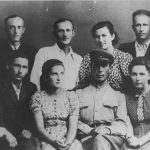
- Portrait of survivors of the Sobibor uprising with Leon Feldhendler at top right and Alexander Pechersky third from left. Photo credit: Unknown source, Public domain, via Wikimedia Commons
-
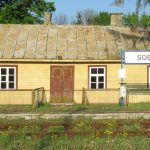
- Sobibór Station Photo credit: Grzegorz W. Tężycki, CC BY-SA 4.0 creativecommons.org via Wikimedia Commons
-
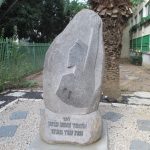
- Alexander Pechersky memorial in Tel Aviv Photo credit: Avishai Teicher, CC BY-SA 4.0 creativecommons.org via Wikimedia Commons
The Aftermath
Alexander led a group of 59 escapees but decided they needed to split up into smaller groups to avoid detection. He went further with 9 Soviet POWs and they crossed the Bug River during the night of 19th – 20th October. The group joined Soviet partisans near Brest-Litovsk, which had been part of inter-war Poland but was incorporated into Soviet Belarus on the basis of the so-called non-aggression pact between Hitler and Stalin. Under this pact, otherwise known as the Molotov – Van Ribbentrop Pact after the respective foreign ministers who signed on behalf of the Soviet Union and Nazi Germany, Western Poland was incorporated into the Third Reich whilst much of Eastern Poland was incorporated into Soviet Belarus. So, the Belarus connection was reignited.
Alexander’s group made it to the Skrodnitze forests where they eventually came into contact with Jewish partisans led by Yehiel Grynszpan. Unsurprisingly Alexander adapted quickly to life as a partisan and fought as a demolition and sabotage expert with Yehiel’s Group and later joined a Soviet group of Voroshilov Partisans and also fought with the Schors Partisan Brigade of the Brest Union until this Brigade was merged into the Red Army in April 1944.
At this point Alexander was redrafted into the Red Army and in typical Soviet fashion he was ‘rewarded’ as a former POW with 2 weeks in a NKVD (Soviet secret police) filtration camp before being sent to the front in a penal assault battalion tasked with carrying out the most dangerous (often suicidal) missions. During his time with the penal battalion he was promoted to Captain and also received a medal for bravery. His commander in the Battalion Major Andreev was clearly shocked by the events Alexander recounted to him about Sobibor and sent him to give evidence to the succinctly named ‘Commission of Inquiry of the Crimes of Fascist-German Aggressors and their Accomplices’ in Moscow and his testimony was published in the Complete Black Book of Russian Jewry edited by Ilya Ehrenburg and Vasily Grossman.
After returning to the Front Alexander was wounded in fighting near Bauska in Latvia and discharged to Military Hospital No. 2660 in the village of Shchurovo, Kolomensky District in Moscow Region where he met his soon to be second wife Olga Kotova. Alexander and his new wife went to live in Rostov-on-Don where they lived for the rest of their lives.
Post-War: back in the USSR
On his return to Russia, Alexander wrote his first memoir ‘Memories of the Sobibor Uprising’. A heavily censored version was published in the Soviet Union and in 1945 his book ‘Uprising in the Sobiburovsky Camp’ was published by Rostizdat, a prominent regional state publishing house based in Rostov-on-Don, with a circulation of 5000 copies. A Yiddish version was published in 1946 by Der Emes, a Moscow publishing house, which was translated into Polish and published in 1952 with an English version following in 1966. Today in Minsk Shirokaya Street has been renamed Kuybysheva Street and the site of the labour camp is located in close proximity to the Komarovsky Market in central Minsk.
However, in typical Soviet fashion, despite the nature and extent of his heroics, the Soviet leadership were reluctant to appear impressed due to their paranoia about anyone who had been in German captivity. Such paranoia also meant that he received the medal for Military Merit rather than the more prestigious Order of the Great Patriotic War for which he had been nominated for his heroics on the battlefield.
Alexander revived his love for the theatre and found work in an administrative job at a music theatre. The post-war period in Stalin’s Soviet Union was characterised by a rise in antisemitism and a campaign of repression against ‘rootless cosmopolitan’ Jews was unleashed. Alexander was caught up in these repressions and lost his job and was expelled from the Communist Party. Alexander was effectively unemployed and unemployable until after the death of Stalin in 1953 when he finally found work in a machine factory.
During the immediate post-war years he testified in a number of trials of former Sobibor guards in Moscow, Krasnodar and Kiev. However, he was prevented by the Soviet authorities from testifying at trials outside the Soviet Union at Nurenberg and the Eichmann trial in Israel. According to his daughter, the last time he was refused permission to testify at a trial outside the Soviet Union was for a trial in Poland in 1987, despite Poland being Communist and part of the Warsaw Pact. The paranoia of the Soviets knew no bounds and they were also reluctant to publicise the fact that so many Soviet fighters had been in German captivity. In 1963 he testified during a Soviet trial of 11 former Sobibor guards, all of whom were obviously found guilty and 10 of whom were executed in a typical display of Soviet justice.
From the late 1950s onwards Alexander started searching for former Sobibor prisoners who had returned to the Soviet Union and was active organising meetings and reunions, collecting materials and artefacts about the Camp, corresponding with Soviet and foreign historians and
journalists and telling the Sobibor Uprising story at public events and in schools. However, his repeated attempts to gain permission to leave the Soviet Union temporarily remained unsuccessful, even to return to Sobibor for the opening ceremony for the new monument at the site of the Camp in 1965 and to the United States for the premiere of the film ‘Escape from Sobibor’ in 1987.
Alexander passed away in Rostov-on-Don on January 19th 1990, bringing down the curtain on an incredible life for which he never received the credit he so obviously deserved, at least not during his lifetime, due to the intransigence of the Soviet leadership and system. He is buried at the Northern cemetery in Rostov-on-Don. A small memorial plaque was erected on the house where he lived in 2007 and a local school was named after him with a monument being erected close to the school in 2018. There are also some memorials in the United States and one in Tel Aviv and streets bear his name in Israel and in Moscow. In 2013 he was posthumously awarded the Knight’s Cross of the Order of Merit of the Republic of Poland and in 2016 Putin awarded him the Russian Order of Courage.
Whilst it is clearly positive and no doubt a source of pride to his family that his heroics are finally starting to receive the recognition they so obviously deserve, it is a bitter-sweet irony that they were not recognised during his lifetime by the leaders of the country he so heroically served. It is also ironic that his story is possibly better known in the West due to the release of the films about the Sobibor Uprising than it is in Russia.
The first Memorial at the Sobibor site was opened in 1965. After extensive research and excavations a new Memorial and small Museum was opened in 2020 at the same location. The excellent new Museum and permanent exhibition was fully operational on my most recent visit in April 2023 although the Memorial itself was still being renovated. Once the renovations are complete then the plea by Alexander Perchersky to ‘Let the World know what happened here’ will have been fulfilled.
Conclusions
The wartime exploits of Alexander ‘Sasha’ Pechersky and particularly the story of the Sobibor Uprising are amongst the most incredible stories of the Great Patriotic War. The oddities of the Soviet regime and system prevented Alexander receiving the credit he deserved during his lifetime as well as denying him the opportunity to present his valuable testimonies against perpetrators in trials outside the Soviet Union. The refusal to allow him to attend the opening ceremony of the Memorial at the site in 1965 seems to be particularly tragic.
Although the story of Alexander’s extraordinary life begins and ends in Rosov-on-Don in southern Russia, the majority of his wartime story is situated in Belarus, both his time in camps in and around Minsk before being transported to Sobibor and his exploits with Jewish and Soviet partisans in the forests of Belarus after the Uprising. Further evidence if it were needed that whatever Holocaust related events we examine, especially the Holocaust in the East, Belarus plays a key role and lies at the epicentre of the Holocaust.
Neil Adams
Fund raising and Education Research Coordinator
The Together Plan
[email protected]
19th February 2026
On April 26th, The Together Plan will be holding a cultural evening in north London. This will be a two part event with supper. The first part of the evening will be a workshop exploring the artworks of Mayer Kirshenblatt and his memories of his shtetl home in Opatów (known as Apt in Yiddish) and photographic works by photojournalist Lewis James Phillips exploring his latest work on Sobibor. Click here for more information.