
When Debra Brunner first invited me to attend the AEPJ European Routes of Jewish Heritage Annual Incubator in Bologna, I felt a mixture of both excitement and curiosity. For me, this was my first time stepping into a room filled with people from across Europe who are involved in creating or developing a Jewish Heritage Route in their own country. I wasn’t entirely sure how I would feel to suddenly be surrounded by individuals who share such a specific and meaningful mission, but I soon realised that this gathering was going to be far more impactful than I had imagined. It was a vivid reminder of the shared responsibility we hold in safeguarding Jewish history, memory, and cultural identity.
The atmosphere was immediately welcoming. With representation from Italy, Turkey, Poland, Bratislava, Azerbaijan, Germany, Strasbourg, Spain and Belarus (as well as lecturers and facilitators from the UK, Sweden, the Netherlands and Italy), some participants were working to preserve centuries-old synagogues; others were developing digital tools to bring forgotten neighbourhoods back to life through virtual storytelling. Some were working in cities with deep, vibrant Jewish pasts; others in places where Jewish traces are fragile or almost invisible. Yet regardless of whether someone was dealing with physical restoration, academic research, community engagement, or digital storytelling, the passion behind their work felt remarkably similar. Many were engaging local communities and municipalities to ensure that Jewish heritage is understood not as a relic of the past but as an active part of Europe’s cultural fabric.
-

- A day in Forli – workshop on dissonant architectural heritage in the birthplace of Benito Mussolini

-
- Workshop study group on the theme of Everyday Jewish Heritage Indicators

-
- Workshop with heritage practitioners and fellow AEPJ members

-
- Lunch with fellow conference delegates

We were all united in the same mission, regardless of nationality, to give voice to Jewish stories embedded in the landscapes, cities, and communities of Europe. I think what impressed me the most was that not all of the participants were Jewish. Still, they demonstrated just as much passion for the Jewish heritage of their country as we did. There is something incredibly powerful about meeting people from different cultural and historical contexts who nevertheless share the same desire: to make Jewish heritage visible, relevant, accessible, and respectfully understood.
At times I felt almost overwhelmed, not in a negative way, but in the sense that I was suddenly exposed to a much bigger picture of what it means to build a heritage route. It’s not simply connecting locations on a map; it’s about shaping a narrative that honours past lives, fosters understanding in the present, and plants seeds of awareness for the future.
Everyone was genuinely congratulatory and were in disbelief as to how The Together Plan had managed to accomplish the creation of the Brest Memorial. It became clear just how moved people were by the dedication and perseverance behind the project, especially given the historical sensitivity and the many challenges involved. Their reactions underscored just how meaningful this achievement truly is.
-
- Lecture on Transnational cultural networks

-
- Tracey presenting feedback in the Mayer Kirshenblatt workshop

-
- Debra Brunner thumbs through the siddur at the Bologna Synagogue in Via Mario Finzi

-
- One of the paintings by Mayer Kirshenblatt used for the workshop on addressing the absence of architectural heritage through memory and narratives

The workshops were varied and wide-ranging, but the ones I found most engaging was the session on Everyday Jewish Heritage Indicators. Its goal was to help us understand the importance of everyday heritage. What it would mean to have a thriving European Jewish Heritage Route. How would living along such routes feel if such heritage exists, is protected and celebrated. The workshop, presented by the Taube Centre for Jewish Life and Learning (Warsaw), guided us into the complex field of addressing the absence of architectural heritage by turning to memory and the powerful narratives it preserves.
We spent time exploring how personal stories, communal recollections, and cultural fragments can fill the void left by lost physical structures. In particular, we focused on artwork from the Through the Eyes of Mayer Kirshenblatt exhibition, examining selected paintings in depth. By looking closely at the imagery and the stories behind them, we were encouraged to consider how memory – visual, emotional, and generational – can serve as a form of heritage, preserving what can no longer be seen in the physical landscape.
-
- Interpretation workshop on the original mosaic cycle by Angelo Canevari at the Bruno Mussolini Aeronautical College now a primary and middle school

-
- Discussion group – interpretating the dissonant mosaic artwork by Angelo Canevari and its use as a propaganda tool

-
- Interpretation workshop on the original mosaic cycle by Angelo Canevari at the Bruno Mussolini Aeronautical College now a primary and middle school

-
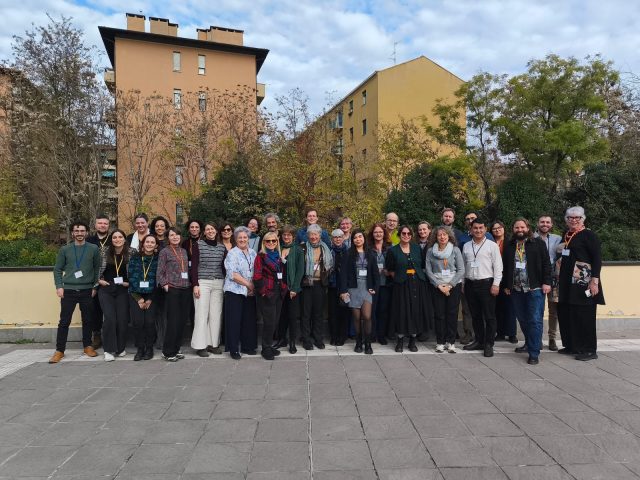
- The AEPJ 2025 Incubator delegates

As the days went on, my initial curiosity transformed into a deeper sense of understanding. I found myself reflecting on how important it is simply to be in the presence of others who care about heritage, not as a hobby or an abstract academic interest, but as something profoundly human. Each conversation seemed to add another layer to my understanding of what this field can be: creative, collaborative, emotional, challenging, and immensely rewarding.
Personally, the conference reaffirmed why I wanted to be involved in The Together Plan in the first place. Jewish heritage is not confined to museums or archives; it is woven into the streets, traditions, and memories that shape our present. Being surrounded by others who understand the value of this work, and who are pouring their energy into ensuring these stories endure, was deeply motivating.
Looking back, I can say that my first AEPJ conference was not just a professional milestone, it was a personal one. It deepened my commitment, expanded my perspective, and reminded me why the work of The Together Plan matters. Most of all, it reassured me that the responsibility to preserve and promote Jewish heritage is shared, and that there is strength in this shared mission. This first experience with the AEPJ community opened my eyes not only to what is possible, but also to how much stronger we are when we work together.
For more information about The Together Plan’s Jewish Route through Belarus – click here
For more information about the AEPJ European Route of Jewish Heritage – click here
J