
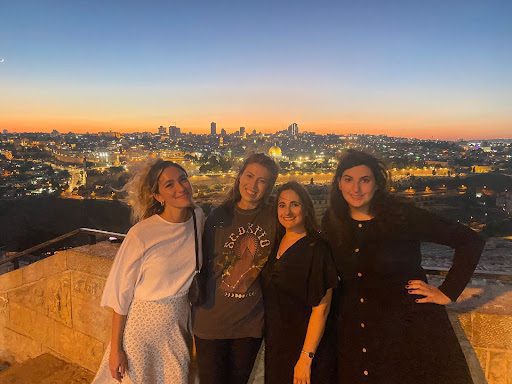
Tasha with friends from the TALMA teaching fellowship in Jerusalem. From right to left_ Micaela, Tasha, Chaya, and Ari
By Tasha Ackerman
On October 7th, I was woken up earlier than usual. I had just returned to my caravan in Ben Shemen the night before, settling in for a quiet Shabbat before returning to work teaching English at the Youth Village where I live and work after two weeks of vacation for the Chagim. Even though I had not been raised observing Judaism, since moving to Israel two months prior I had begun integrating Jewish traditions and rituals into my life. For that reason, I hadn’t received any notifications on the morning of October 7th about what was happening around- having set a special “Shabbat” focus mode on my phone that automatically silenced notifications in the spirit of the weekly holiday. Before getting out of bed, I began to feel the distant booms, like a rumbling in my chest. It reminded me of the first time I felt an earthquake, an unknown sensation having grown up in the flat Midwestern region of the US. I wondered, are these rockets?
I got out of bed to glance at my phone and began to understand what was happening around me. My neighbour, and friend, had sent me a message, in case you are wondering what the banging is… Don’t freak out, it’s rockets. I hadn’t had time to freak out yet and responded to ask if we should go to the shelter. Not unless we hear sirens… but just seconds later, the sirens began to wail. Still in my pyjamas, I scooped up my 5kg dog and ran to the Miklat, an underground shelter, down the road.
When I began my application for Aliyah in 2021, I felt like I was starting from scratch. In order to apply for Aliyah, one begins by gathering several documents, such as birth certificates and travel records. But for me, before beginning to gather these sorts of documents in order, I knew the biggest challenge would be obtaining the required ”Proof of Judaism” letter from a rabbi.
Growing up, I had never belonged to a Jewish congregation. My father was raised Jewish and attended a synagogue where had his Bar Mitzvah in North Minneapolis called Tifereth B’nai Jacob. However, The “Near North” neighbourhood where my Yiddish-speaking great-grandparents had migrated to from Romania and then Bessarabia and raised my grandfather had once been a strongly Jewish part of the city, with Jewish-owned delicatessens and markets and had several synagogues. It was an area where Jews and African Americans lived as neighbours in a part of town where they mutually built a community. Though, in the 1950s and 60s, many Jewish families began moving towards the western suburbs, and after race riots in 1967 where many Jewish-owned businesses were destroyed, most of the Jewish businesses left and the last synagogues in the neighbourhood relocated west.
After my father’s synagogue merged with another synagogue in the suburbs, his family did not follow the congregation and became disengaged with organized Jewish life. So growing up, my exposure to Judaism was through family celebrations. Later, I participated in Jewish groups through my university and eventually travelled to Israel, first on a Birthright Trip to and later on a summer teaching fellowship in Eilat. Additionally, my mother is Catholic, and I grew up celebrating holidays through both religions and building my own spiritual connection to ritual and family gatherings. But as I grew up and had more agency in the community spaces in which I felt accepted, Judaism and Israel began to represent a sense of community and of acceptance where people looked out for each other in a profoundly connected way. These spaces reminded me of the neighbourhood where I had grown up in the suburbs, a cul-du-sac where, like my own family dynamics, were split between Jewish and Catholic families and where everyone’s doors were open and we fed and supported one another.
After my second trip to Israel, I began considering Aliyah, but I was stuck with the initial issue of who would write my proof of Judaism letter. Even though my father was born Jewish, generations had passed without anyone officially belonging to a congregation in my family. I reached out to a good friend, Danielle, whom I had grown up with in Minnesota and who had served in the IDF. I asked if she could connect me with her family rabbi, thinking if I could share my story he may be able to write the letter for me.
When I met with Rabbi Davis of Beth El, I explained how my father was Jewish and my mother was Catholic, but how discovering my Jewish identity brought me the sense of connection that I value so highly, that deep in my gut I know that Israel is part of my journey, and the sense of home and belonging that I felt there. Through the Law of Return, he acknowledged that I was eligible due to having a Jewish Father and Grandparents, though to accept me as Jewish in his conservative synagogue, he advised me to go to the Mikvah and to declare my Judaism to the Beit Din. So a month later over Hannukah, I found myself fully submersed in this ritual immersion, repeating Hebrew prayers that felt foreign yet familiar, and committing myself to a Jewish life.
However, my journey hasn’t been as simple as I imagined it would be after obtaining this letter. In addition to this Proof of Judaism letter, the Jewish Agency after reviewing my case followed up wanting more proof of Judaism. They wanted a rabbi’s letter also declaring my father as Jewish, my father’s birth certificate and my grandparents’ marriage certificate. This is when I started digging into family albums, seeking any evidence of my family’s Jewish ancestry and trying to better understand for myself how my family history has influenced the person I am.
In one photo album, my nana had made, spanning my father’s life from childhood through his thirties, amongst professional-looking black and white photos of my dad playing with his siblings and celebrating birthdays, I suddenly found proof ‘Jackpot!’ My nana had saved; a personalized Kippa and napkin from my father’s bar mitzvah dated April 24, 1971; a letter scribbled to his parents from Camp Tikvah in 1968; a newspaper clipping of my father dressed in costume for a Purim party at Talmud Torah; a photo of my nana dressed more modestly than I had ever seen standing in front of The Western Wall. A Jewish history that I knew was always a part of me, suddenly became visual in front of my eyes.
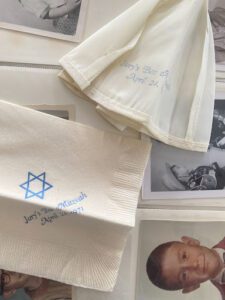
Kippah and napkin from Tasha’s father’s bar mitzvah
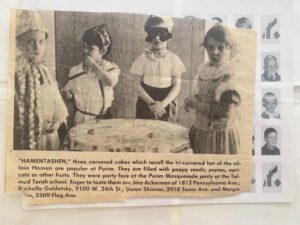
Newsletter clipping featuring Tasha’s father at Purim Masquerade party at his Talmud Torah school in Minneapolis
I deepened my search, using online databases to try to answer questions about the family members that pre-dated me, to understand their stories and their journey from Eastern European shtetls to America. I found my great-grandparents’ language listed as Yiddish on US census records, their travel documents crossing the Atlantic, and began hypothesizing what could have brought my Romanian great-grandmother from New York to Minneapolis, where, to my knowledge, she wouldn’t have known anyone.
While I continued to pursue Aliyah, and was researching and writing my history, I discovered The Together Plan through an online posting for volunteers. I recall with each tab on the website getting more excited, because even though my ancestry is not through Belarus- I could relate to the mission of discovering community through research, exploration, and cultural engagements. I first applied to be a caseworker with the archive services in February 2023, and later began writing stories profiling members of the community.
In August 2023, after nearly two years of thinking of Aliyah, I made it to Israel after accepting a full-year fellowship teaching English with TALMA, an organization committed to increasing English proficiency to students living on Israel’s geographic and economic periphery.. Since I had prepared for this move for years and had been investigating my Jewish identity, both in my life and through my family history, this time being in Israel felt even more special. I felt grateful stuffed on the overcrowded light rail as it ploughed down Jaffa Street in Jerusalem, just happy to be amongst this diverse people in the controlled chaos that makes these ancient streets still feel so alive. I relished dipping my toes in the Mediterranean, in Tel Aviv, letting the mix of matkot balls clanging with the chatter of Hebrew, English, Russian- a mix of languages always present on the city’s shores.
Tasha with friends from the TALMA teaching fellowship in Jerusalem. From right to left_ Micaela, Tasha, Chaya, and Ari
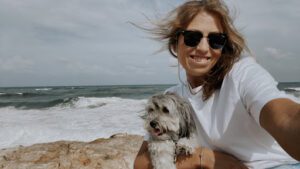
Tasha and her dog, Lulo, in Tel Aviv
I knew inevitably living in Israel, that conflict would at some point arise – though no one could have expected the scale of the attacks on October 7th and the war to follow. Yet, I was now armed with a community near and far to combat all of the complex feelings and fears that accompanied this new experience. During the first week of the war, I spent time close to my community in the village, led virtual yoga sessions for the fellows on my programme, attended The Together Plan’s archive team meeting, and connected with a new immigrant from Belarus to write her story about living in Israel during this time – click here to read the story that I wrote. I learned of the magic of Israelis and Jews, checking on one another, offering support in whatever way they can, and finding beauty and love amongst immense pain and grief.
Ordinarily, you don’t feel a sound, you hear it! But when the Iron Dome intercepts rockets, it’s a full-body experience. And since the war, I’ve felt antisemitism in the same way. It’s more than an emotional wound, it feels like a physical threat to my safety – a sinking of my heart and tightening in my gut. In Israel, when the war began and people asked how I was doing, my response typically was – My heart has never felt so shattered and full at the same time. While I’m devastated and scared, the camaraderie of Israelis and Jewish people reminds me of why this journey has been important for me the whole time, of what it means to be a Jewish person and why we will continue to persevere, as we have always done in the face of adversity. Similarly to the light of the candles on the menorah, that shone longer than anyone could have anticipated, we remind ourselves of our perseverance through our rituals and commitment to one another.
In November, my Aliyah was finally approved, and so I returned to my hometown in Minneapolis in order to obtain the visa and plan for my official return home to Israel. When I fly back to Israel on December 13th, I will arrive as an Olah Hadasha, a new immigrant. Arriving during Hanukkah, two years after declaring my Judaism to the Beit Din during the holiday in 2021, it feels like I am still carrying that light, which fills my soul with the strength to be with my community and hold hope during this time.