

On what was once Staro-Vilenskaya Street in Minsk, a building has stood since 1907 – through empires, wars, occupations, and regime change – and has never once fallen silent.
It began life as a distillery on the banks of the long-vanished Perespa River, built and run by a Jewish family. From its earliest days, the building carried a Jewish heartbeat: its workforce was almost entirely Jewish, and a prayer room was set up on site so workers could observe the Sabbath right up until the moment it began. Over the following decades the building changed hands and purposes again and again – a yeast factory, a garment cooperative, a wartime production site, a Soviet consumer goods combine. Through every transformation, the address at what is now 13B Daumana Street endured.
Then, in 1994, as Jewish life across the former Soviet Union began to stir back to life after generations of suppression, the building was transferred to the Jewish Religious Union of Belarus. It became, once again, a home for the Jewish community of Minsk.
Thirty years later, it still is.

-

- Daumana Street Synagogue, 2026

-
- Daumana Street Synagogue, 2026

-
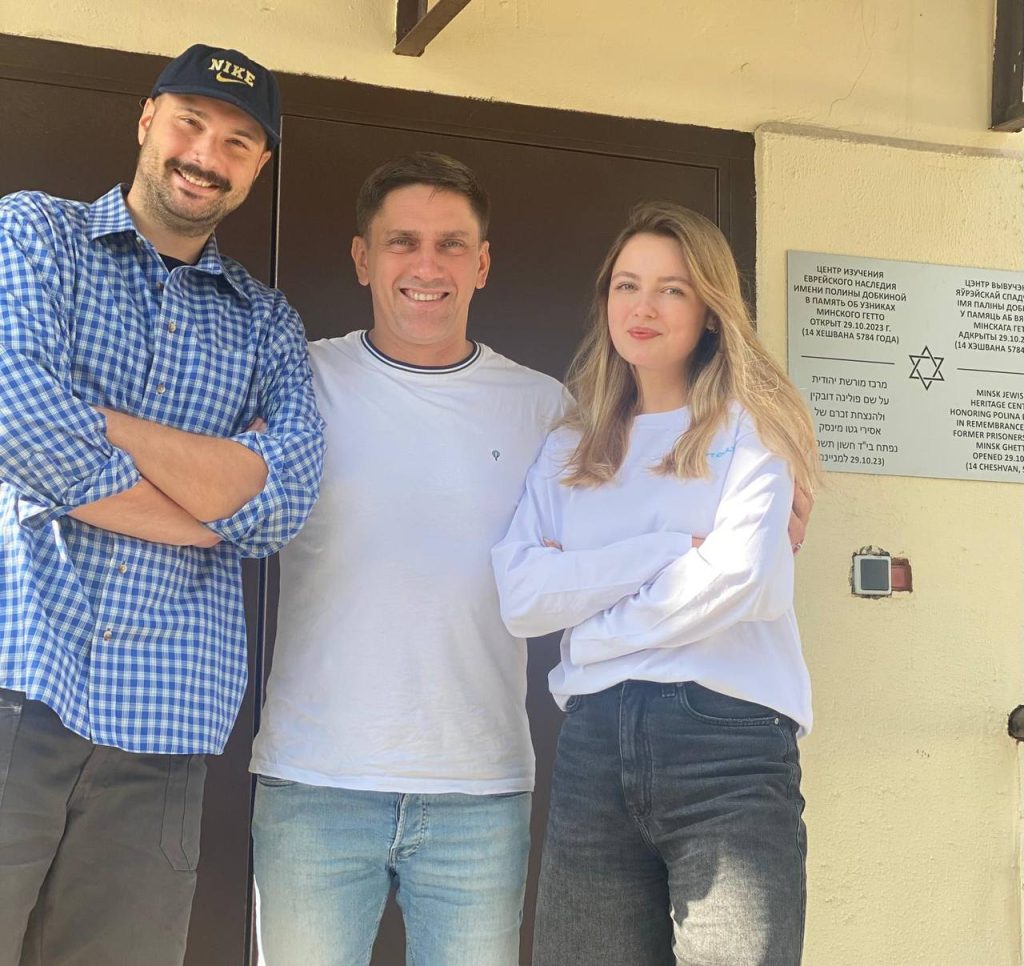
- Polina Dobkina Center for Jewish Heritage – outside

-
- territory of the Daumana Street Synagogue, 2026

what the building holds today
Walk through the doors of 13B Daumana Street now and you find a five-storey, 2,200-square-metre building that is, quite simply, the only one of its kind in Belarus – a single address dedicated entirely to the religious, cultural and organisational life of the country’s Jewish community.
Two congregations, Lech Lecha and Beis Yisroel, each occupy a full floor, free of charge, gathering together for Shabbat and swelling to double their numbers for the festivals. Two kosher kitchens quietly do the work that keeps community life possible – preparing food for Shabbat and the holidays, baking challah, and providing free meals to elderly residents, large families and people with disabilities who would otherwise go without. Downstairs is the only mikveh in Minsk, open at no charge to any Jewish visitor, including those simply passing through.
-
- Lech Lecha Jewish community

-
- Lech Lecha Jewish community – Purim celebration 2026

-
- Beis Yisroel Jewish community – Sukkot celebration, COPYRIGHT Beis Isroel

-
- Beis Yisroel Jewish community – Rosh Chodesh Nisan, COPYRIGHT Beis Isroel

Upstairs, Yeshiva Gdolah de Minsk and a kollel keep Torah study alive for a new generation of Belarusian Jewish men – a living link to a scholarly tradition that seemed, within living memory, to have been extinguished entirely.
The building is also home to the Polina Dobkina Center for Jewish Heritage, which since its renovation has hosted around 100 lectures, film screenings, book launches and memorial evenings, drawing 3,500 to 4,000 visitors through its doors. The Jewish Heritage Club brings together 20 to 60 people, mostly elderly, several times a month – often the only regular social contact many of them have. The Stars youth programme gathers the next generation twice a week for Torah study with a young rabbi. Maccabi Belarus, the historic Jewish sports movement once all but erased, was revived here in January 2026 and now fields a futsal team, a women’s flag football team, and a boccia team for players with special needs.
-
- opening of the Minsk Jewish Heritage Centre, 29 Oct 2023

-
- film club at the Minsk Jewish Heritage Centre

-
- STARS meeting – youth of the Lech Lecha Jewish community

-
- Jewish wedding at the Minsk Jewish Heritage Centre

The editorial office of Berega – the only Jewish newspaper in Belarus – is based here too, printed monthly and distributed as widely and cheaply as possible so that no one is priced out of staying connected to community life.
And behind all of it, the building serves as the administrative headquarters of the Jewish Religious Union, whose team of 15 staff and volunteers coordinates support for 16 Jewish communities scattered across Belarus – communities for whom this single address in Minsk is, in a very real sense, the centre of the wheel.
more than a building
It would be easy to describe 13B Daumana Street simply as a well-used communal facility. But that undersells what it actually is. This building is the reason Jewish life in Belarus has a pulse at all – the place where a nearly-lost sporting movement was reborn, where a scholarly tradition thought gone is being quietly rebuilt, where the only Jewish newspaper in the country is written and printed, and where sixteen far-flung communities find their common centre of gravity.
It is, in the fullest sense, the heartbeat of the Jewish Religious Union of Belarus.
a building at a crossroads
But a heartbeat, however strong, depends on the body that carries it – and this building’s body is failing.
Behind the walls and beneath the floors, the systems that keep 13B Daumana Street standing date largely from the Soviet era and have never been comprehensively replaced. The heating system no longer meets basic safety standards. The electrical switchboard was installed in the post-war period and much of the wiring running through the building is now the kind that is prohibited under current safety regulations. Twice this year, ageing drainage pipes have burst beneath the floors, flooding offices and forcing the Union to absorb the cost of emergency repairs out of its own stretched resources. The roof still leaks into the heritage centre during heavy rain. None of it has been touched since the building was handed to the Union in 1994.
This is not a wish list of improvements. It is the difference between a building that continues to function and one that authorities are forced, on safety grounds, to close.
The team who run this building have already done something close to miraculous. Since taking on responsibility in 2023, with almost nothing to work with, they have renovated the heritage centre, repainted and repaired the facade, installed security infrastructure, and patched the roof’s worst failures – all while keeping the mikveh running, the kitchens cooking, the Yeshiva teaching, and sixteen communities across the country supported. It has been done through sheer determination, on a shoestring, by a handful of people.
-
- Jewish Heritage Centre – during renovation, 2023

-
- territory of the Daumana Street Synagogue – before 2023

-
- Daumana Street Synagogue – before renovation

-
- Minsk Jewish Heritage Centre – before renovation

But that determination has limits, and the building has reached one of them. The Union’s only reliable income is the rent from half-empty commercial space in a building that urgently needs the money spent on it instead. There is no state support. There is no reserve to draw on. And the strain is already visible in the most painful way possible: Berega, the only Jewish newspaper in Belarus, has had to pause printing simply because the budget to produce it no longer exists.
For readers in London or New York, a paused newspaper might sound like a minor casualty. For an elderly Jewish woman in a small Belarusian town, with no synagogue nearby and little other connection to Jewish life, Berega arriving through the post each month has been exactly that: a lifeline. Losing it, even temporarily, is a real and immediate loss – and a warning sign of what else is at risk if nothing changes.

This is the honest position the Jewish Religious Union of Belarus is in. A tiny team has kept this building, and everything it makes possible, alive against considerable odds. But keeping it alive for the next generation – rather than simply keeping it standing for another few years – needs help that cannot come from inside the building alone.
what it could become
What makes this story remarkable is not only what this building has survived, but what it could still become. The bones of something extraordinary are already in place – they simply need the investment to grow into their full potential.
The Yeshiva Gdolah de Minsk and its kollel could be revived and expanded into a genuine centre of Torah scholarship, drawing students from across the region rather than functioning at a fraction of its capacity.
The Polina Dobkina Center for Jewish Heritage, already drawing thousands of visitors a year to its lectures and exhibitions, could grow into a true Jewish heritage centre of excellence – a destination for scholars, descendants tracing family history, and visitors from abroad, anchoring Belarus’s place in the story of Jewish Eastern Europe.
The building’s two floors of religious life, its mikveh, its kosher kitchens, and its prayer halls could become a fully resourced central space for prayer and community – one able to properly serve not just the congregations of Minsk but the sixteen communities across the country who look to this address for support.
And the wider building – the administrative hub, the newspaper, the youth programme, the revived sports movement – could operate as the confident, well-equipped centre of a Jewish communal life that stretches across an entire country. Moreover, there is even space for a museum that would tell the story of the Jews of Belarus, the Holocaust and the 504 ghettos that stood on the territory of Belarus.
None of this is speculative. It is already happening, in embryo, inside these walls, run by a small and determined team on a shoestring. What 13B Daumana Street needs now is not reinvention, but the resources to grow into everything it already has the foundations to be – and, first, the resources simply to keep standing.
why this is everyone’s story
Somewhere in the world, right now, there are people whose grandparents or great-grandparents once lived, prayed, worked or studied within a few streets of this building – in Minsk, or in one of the sixteen communities across Belarus this address quietly supports. For many of them, Belarus is a name on an old document, a story half-remembered, a place they’ve never been able to visit but can’t quite let go of.
This building is where that inherited connection becomes something real and ongoing. It is where the community their ancestors belonged to still gathers, still prays, still teaches, still publishes its newspaper, still shows up for its elderly and its children. Supporting 13B Daumana Street is not a distant act of charity – for many, it is a way of finishing a sentence their own family history left unfinished.
We believe that if people across the world with ancestral links to Belarus come together now, collectively we can do what our small team on the ground cannot do alone: secure a future for this building, and for the Jewish life it holds.
This building has never stopped – not for a century of war, occupation, and upheaval. It is standing at a crossroads today, closer to closure than it has ever been. The next chapter of its story is the one where, together, we make sure it doesn’t just survive, but truly thrives.
The Together Plan and its sister non-profit in the USA, Jewish Tapestry Project work in partnership with the Jewish Religious Union in the Republic of Belarus to support Jewish community life, heritage and humanitarian aid across Belarus.To find out more, contact us at [email protected].