
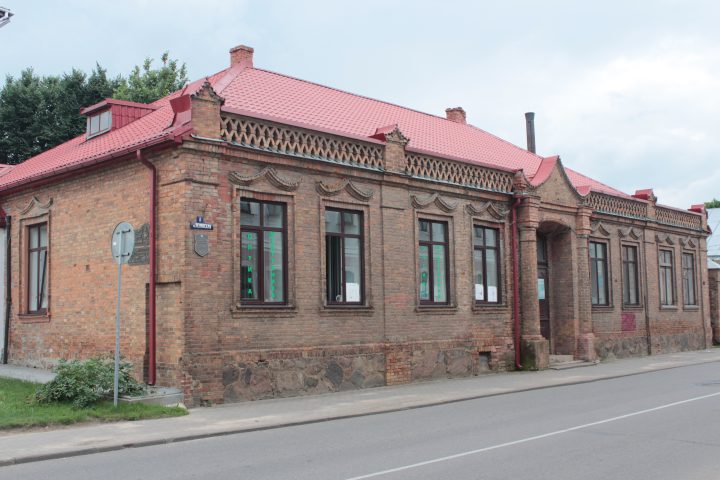
Former Jewish girls' school, Nesvizh Image credit: The Together Plan
Coordinates: 53°13′N 26°40′E
Nesvizh as a town came into being on the banks of the Usha river at the end of the XIII century. Throughout its history Nesvizh was widely known as the main residence of the Radziwills, an extremely rich and influential noble family in the Grand Duchy of Lithuania and later in the Polish Lithuanian Commonwealth. They owned the town, developed it and turned it into a cultural center of the region.
The Radziwill’s castle was built in Nesvizh in the period from the XVI to XIX centuries and is on the UNESCO World Heritage List. Today it is a National History and Cultural Museum Reserve and is open to the public.
-

- Nesvizh Castle Image credit: The Together Plan
-

- Nesvizh Castle Image credit: The Together Plan
-

- Nesvizh Castle Image credit: The Together Plan
-

- Nesvizh Castle Image credit: The Together Plan
-

- 17th century view of Niasvizh – by Tomasz Makowski, Public domain, via Wikimedia Commons
Jews settled in Nesvizh in the second half of the XVI century. In 1586 Stephan Batory, a King of Poland and a Grand Duke of Lithuania, granted Magdeburg Rights to the citizens of Nesvizh, and the Jews received equal rights with Christians, including the right to participate in self-government. As in other towns owned by the Radziwills, the Jews of Nesvizh lived in a so-called jurisdiction of the Prince and were subordinate only to the Radziwills. In 1589 Mickolai Christopher Radziwill gave permission to build a synagogue in Nesvizh and issued a set of rules which regulated the rights and duties of Nesvizh Jews. Among others they had to close the gates for
the night in the streets where they lived and also keep them closed for three days during the Holy Week (a week before Easter). In religious matters the community was subordinate to the kehilah (Jewish community) in Brest (Brisk).
The construction of the synagogue began at the end of the XVI century. and was finished at the beginning of the XVII century. The building was severely damaged during WWII and was totally demolished after the war.
The number of Jews living in the town at that time is not known, yet they were influential. In 1634 a representative from Nesvizh was one of the five men who determined the amount of funds required ‘to wreak vengeance for murder’, referring to a blood libel against the Jews.
A hundred years later the Jews of Nesvizh together with the neighbouring town of Sverzhen paid 1000 zlotys of a poll tax, a sum equal to that imposed on Vilna Jews. The Jews of Nesvizh worked for the Radziwills and prospered. Under their influence one of the Radziwills, Prince Martin Nicholai (1705-1782) fond of Eastern philosophy and alchemy, and who had a whole harem from among his serfs, changed his faith. He converted from Catholicism to Judaism. In response, his relatives put him under house arrest, telling everyone that the prince was mentally ill and so he committed suicide.
In 1811 the Jewish community of Nesvizh listed 716 Jews: 153 of them were craftsmen, including 91 needle workers, 21 tanners and 13 barbers.
-

- Former Kazimierz Synagogue, today the fire department Image credit: The Together Plan
-

- Former synagogue building – today a privately owned building Image credit: The Together Plan
-

- Former Jewish shopping arcade, Nesvizh Image credit: The Together Plan
-

- Former Jewish girls’ school, Nesvizh Image credit: The Together Plan
-

- Fomer Jewish Craftsman’s house, Nesvizh Image credit: The Together Plan
In 1913 the Jews of Nesvizh owned two pharmacy warehouses, 30 shops and kiosks, 3 groceries and 3 wine shops. Besides commerce and crafts they engaged in horticulture and market gardening. Jewish merchants traded leather, hemp, flax and wheat.
There was one great synagogue and seven smaller synagogues/praying houses in Nesvizh at that time.
One of the greatest religious leaders – the Gaon Reb Yitzchak Elchanan Spektor (5577–5656 /1817–1896) moved to Nesvizh in 1846 and served as a Rabbi until 1851 when he moved to Novogrudok. Another renowned Talmudic scholar from Nesvizh was Samuel Avigdor ‘Tosfa’ah’. A native of Nesvizh was Joseph Baer Soloveichik.
-

- Salvaged gravestones from the Nesvizh Jewish cemetery, now a public park Image credit: The Together Plan
-

- Monument to the Jews executed in October 1941 Image credit: The Together Plan
-

- Monument to the victims of the Nesvizh Ghetto Image credit: The Together Plan
-

- Matzeva that once stood in the Nesvizh Jewish cemetery Image credit: The Together Plan
After 1880 due to pogroms in Russia there was a wave of emigration (mostly to the US) and the Jewish community of Nesvizh decreased. According to the census of 1897 4,687 Jews lived in the city, yet, the demographic situation changed for the worse with revolutions and a Civil war between Poles and Bolsheviks. Just before the end of the war in 1920 Polish troops made a pogrom in Nesvizh.
In 1921 when the second Republic of Poland was established, 3,346 Jews lived in Nesvizh (48,9%). As a result of WWI, after two years of static warfare around Nesvizh, many of the Jews were poor. The community organised help for the needy on Jewish holidays. There were some doctors (volunteers) who tended to the sick.
After WWI the area fell under Poland, peace resumed and life began to improve. A cooperative Jewish bank was opened in 1922. In 1923 the Poles established their own currency, the Zloty, and a prosperous era began. Different businesses developed; Jews owned a textile factory, a sawmill and practically all shops, taverns and hotels in Nesvizh belonged to the Jews. The community had a yeshivah, a Yiddish school ‘Volkschule’, a Hebrew school ‘Tarbut’ and a kindergarten. Elementary education was provided by chederim – private schools at home.
There was a summer resort for children in the forest 4km away from Nesvizh. The poor did not have to pay for staying there, but for those who could pay, it was very expensive.
Besides Jewish schools, there was a Polish gymnasium (school) and an eight-year secondary school where a few Jewish youth studied. There were two prep schools for entering the gymnasium. Both were run by former teachers who were retired and well known to Polish intelligentsia. One was the private school of Berenzhvichova and the other of Mikuchova. Preparation to enter the gymnasium lasted three years.
There was considerable Zionist activity and in the 1930s Hashomer Hatzair had their own clubhouse and maintained a training farm in Nesvizh. They operated under the banner of a sports club (to keep the Zionist activities hidden from the authorities) and had a sports field near the club house, mainly for handball. Young Jews who dreamed about Israel, had a battalion with four platoons which had Hebrew names. They sang songs about Eretz Israel, listened to lectures about Israel, socialism, communism, revolutionary movements across the ages, the Russian revolution, etc. In spring they went out to the forest to celebrate Tu Bishvat (the holiday of the trees), and called these excursions ‘sailings’. In summer they went to camps with the primary slogan of making Aliyah to Eretz Israel. They couldn’t go to Palestine because of British restriction immigration laws, yet they learned about Israel and the kibbutz, and they kept formal and informal connections with Israel. There was also a Betar Zionist organization in Nesvizh. They wore brown uniforms.
Nesvizh had no railway. When the railroad started to be built, the Radziwills did not allow it to go through the town and so the nearest railway station was 14km away in Horodeya.
The Radziwills still lived in the castle. Antoni Radziwill of a Prussian line and his wife came to live in Nesvizh in 1825. (Their daughter Eliza was the first love of future Keiser Wilhelm I). It took them dozens of years to restore the castle which was not suitable for living.
The last of the Radziwills in Nesvizh (until 1939) was Leon Radziwill. He was not an antisemite and had good relations with the Jews as well, but Jews were not allowed in the castle, unless they were needed for example to perform tasks such as hairdressing or painting.
The Jewish community in Nesvizh in the late 1930s was closed and introverted. There was almost no emigration to other countries. The economic situation of the Jews deteriorated. Most of the Jewish youth were unemployed, except for those whose parents earned a modest living with small businesses. There was a growing influence of communist ideas and many believed that salvation would come from the east. Meanwhile, antisemitic propaganda began to spread following the death of Marshal Pilsudski in 1935.
On September 17, 1939 Red Army troops entered Nesvizh and Soviet power was established. A big gathering took place in the town hall where the representative of the Red Army, Nikolay Sirotko (who came from Minsk and later became the first secretary of the Communist Party in Nesvizh) announced that all the stores would be nationalized. The Jews were to sell everything. Synagogues were closed. One was turned into a club, another into a warehouse. People, (all people, not just Jews) had to live on coupons and queue for basic needs like bread, sugar, salt and oil. Jewish schools and all Jewish organisations were closed. Instead Jewish children went to Russian schools. Education was free.
An ‘artel’ (a cooperative) was organised in the town hall, where most of the artisans had to work together. There were many Jews in the militia. In 1940 the new government started to send wealthy Poles and Jews to Siberian gulags. Many did not survive. Under communism Jews lived their lives, obeyed the new rules and conformed. The authorities persecuted the bourgeois but the Jews were not specifically targeted.
Jewish refugees from Poland began flowing into the town as a result of Hitler’s invasion of Poland, and the Jewish population of Nesvizh grew as a result, comprising 57% of the total population (4,500 Jews) by June 1941. Refugees kept together and tried to stay unnoticed. They were afraid of being sent east.
When it was announced on June 22, that Germany attacked the Soviet Union, many Jews tried to escape east but the roads were closed by the Soviet troops and they had to come back. Two days later the Soviet authorities left the town.
German troops occupied Nesvizh on June 27, 1941. Magalif, a Jewish lawyer from Warsaw, organised 12 men to act as the Judenrat located in the Volksschule. The German authorities gave Magalif orders by phone. Their first mission was to bury those killed in battle when the Germans arrived and a very long pit was dug just outside of Nesvizh on the road to Snov where those killed in battle were buried. This site was also a place where Jews were later killed. On October 18 the Germans demanded clothes, shoes and leather. Magalif organised Jewish police who cooperated with the Germans to fulfil their demands. On October 19, 1941 a fine of 500,000 rubles and 2.5 kg of gold, imposed on the Jews, was satisfied. Had it not been, 200 men would have been taken hostage and shot.
On October 30 all the Jews were ordered to come to the market near the city hall at 6 o’clock in the morning on the pretext of getting new identity cards. They were told to be dressed up in their best and to bring their valuables, and that all the families including the old and sick should come. At 9 o’clock trucks with Lithuanians arrived. The selection began. Interpreter Markowski asked for 4 doctors with their families. They took only 2 doctors. Then he asked for 4 engineers. Then came glaziers, blacksmiths, shoemakers, and tailors. Many understood what was going to happen and pretended to be specialists in professions they knew nothing about. 560 artisans were selected and sent to a Polish gymnasium, while about 4,000 were marched to the graves that had already been prepared. 1,500 were brought to the old park called Alba, the closest park to the Radziwills’ castle. The rest were shot on the road to Snov.
A group of 20 women and 10 men was brought to the castle to clean the rooms and make fire. At 4pm Lithuanians brought food and other goods to the castle. The group of Jews was ordered to come to the dining room to eat. Then they were brought back to the market where they spent the night. At 10 am the next day Belarusian police came, and the survivors were ordered to go to the building of the theatre. 585 people were sent back to the ghetto, 180 of them were local, all the rest were refugees. A day later an order came to put a wire fence around the ghetto.
The ghetto, about 150m wide and 250m long was situated around the synagogues and existed for 9 months. In some houses the windows faced the street, and barbed wire was put on the windows.
After the October massacre it was decided to take on armed resistance. Two resistance groups were formed. One was from Hashomer Hazair members, the other formed under the leadership of Moshe Dameshek and Berl Alperowitz. Later both groups joined together under the motto ‘October 30: Never Again’.
Women from the ghetto worked in the workshop, specially established outside the ghetto, near the Orthodox church where they did laundry and sewing and mending. The manager of the workshop was Belarusian. Two women, Leah Duker and Rachel Kagan, worked as cleaners at the Außenkommandatur across the street from the ghetto. Every day, they brought a piece of weapon from the ammunition depot which was situated there. That’s how a machine gun was assembled in the ghetto. The living conditions in the ghetto were better than in other places. There was no starvation in the ghetto. A school and a synagogue functioned, they had firewood to heat their houses in winter. There were no school books, yet, teachers taught about Judaism.
On February 19, 1942 a young couple, Elke Ufiziner and David Farfel, were married in the ghetto. The wedding took place in the Judenrat building. The Rabbi officiated the ceremony, the secretary of the Judenrat, Frida Lachowitzky, registered them as a married couple. Magalif’s wife brought wine and a cake to celebrate, although there were no guests present except for the sister of the bride. Magalif gave a separate room to the young couple in which they lived for the next 5 months. Food was becoming scarce, so they traded through the windows with locals. Some Jews from the villages nearby were moved to the Nesvizh Ghetto. Rumours about the massacre in nearby Snov and the killing of 1,500 Jews of Horodeya on July 16 became a signal to build bunkers and make plans to escape.
On July 17 all the inmates of the ghetto gathered in the synagogue to say Kaddish in the memory of the Jews of Horodeya. Members of the resistance group addressed the assembly with the idea of an armed revolt. Members of the underground resistance group began preparations for the uprising. They had a machine gun, some rifles, hand grenades but mostly cold weapons (knives etc). On July 19 at 5pm an emergency meeting took place in the synagogue. Berl Alperowitz informed about the imminent elimination of the ghetto. They discussed whether to escape before or during the clash with the Germans. Magalif, the chairman of the Judenrat, didn’t give his permission. He thought, if the young ran away, the old and the children would be killed. He didn’t want to be responsible for that. No agreement was reached among the ghetto prisoners. Berl Alperowitz escaped to the forest alone. He was later killed fighting as a partisan.
During that night Magalif was called to the Außenkommandatur. He was told that the ghetto would be liquidated, only 30 Jews who worked at the factory would remain alive. Those who had built bunkers took refuge there. At dusk on July 20 the ghetto was surrounded by Belarusian policemen. Police reinforcements, including Lithuanian auxiliaries from Baranovichi, also arrived to assist in clearing the ghetto. On July 21 those who didn’t have a place to hide (which was around 500 people) came to the main gate of the ghetto. Magalif was told that there would be a selection and that only 30 specialised workers would be allowed to live, without their families. Magalif said that it was the end, but people refused to comply with the order. The police opened fire. At that point the underground resistance group answered with machine gun fire. The uprising began. Some tossed grenades to open the gate and allow the Jews to run away. When the police entered the ghetto, they were met with stones, knives and metal bars. Some houses were set on fire. People tried to hide under the wooden floor in the synagogue which was on fire.
Most of those in hiding spent 5 days and nights without water and food. Altogether 40 Jews managed to survive and join the partisans. Some joined the partisan unit under Fiodor Kapusta in the Kopyl forests, others under Josef Marchwinsky in the Naliboki forest. Josef Marchwinsky was a non-Jew who took Jews into his partisan unit. On February 13th 1968 Yad Vashem recognised him as Righteous Among the Nations.
The revolt in the Nesvizh Ghetto was one of the first and had an impact on the Jews in other ghettos.
The Together Plan is leading a campaign to install two memorials in Nesvizh, at the former Jewish cemetery and in the town centre to honour the town’s once-thriving Jewish community and its lasting legacy. For more information please get in touch [email protected]
Sources:
https://www.jewishgen.org/yizkor/nesvizh/nesvizh.html
https://niasvizh.by/history/istoriya_roda_radzivillov/
https://otpusk-zdorovo.ru/radzivilly-istoriya-roda-i-nesvizhskij-zamok-legendy/
David Farfel ‘In the Nesvizh ghetto and Naliboki Forest’, Ramat Gan, Israel, 2018
Interview with Elka Farfel, October 18, 1996 published by David Farfel
Sholom Cholawsky ‘The Jews of Bielorussia during World War II, Amsterdam, Harwood Academic Publishers, 1998
Sholom Cholawski ‘Soldiers from the ghetto’
Martin Dean ‘Collaboration in the holocaust: Crimes of the local police in Belorussia and Ukraine, 1941-44, London, Macmillan, 1999.
Encyclopedia ‘Holocaust on the territory of the USSR/, Moscow, ROSSPEN, 2009